Online searches are useful. In a matter of seconds, you can look up names, social media profiles, business listings, addresses, property records, news articles, court indexes, and other public information. For everyday questions, a basic search may be enough.
But when the situation is serious, sensitive, or connected to a legal, personal, family, or business concern, an online search often falls short.
A private investigator does more than type a name into Google. A professional investigator looks for accurate information, verifies details, connects records, documents findings, understands legal limits, and provides context that a quick search may miss. This can matter in cases involving infidelity concerns, divorce, child custody, missing persons, witness location, background research, hidden social media accounts, business due diligence, or court-related documentation.
For people in Buckhead and the Atlanta area, hiring a private investigator can be especially helpful when the issue requires discretion, accuracy, and organized reporting. Online searches can produce scattered information. A private investigator’s job is to determine what is relevant, what is reliable, and what can be documented legally.
This article is for general educational purposes only and is not legal advice.
Online Searches Often Produce Incomplete Information
Search engines are designed to find publicly indexed web pages. They are not designed to give you a complete picture of a person’s background, location, behavior, or connections. Some information may be outdated. Some may belong to someone with a similar name. Some may be hidden behind databases, court systems, county records, business filings, or paid tools. Some may not be online at all.
A DIY search can easily lead someone in the wrong direction. For example, an old address may appear as current. A social media profile may be inactive. A name match may belong to a different person. A public record may be misread without understanding the context.
A private investigator can help sort through those gaps. Instead of relying on one search result, an investigator may compare multiple sources, check timelines, review public records, look for inconsistencies, and determine whether information appears current and reliable.
Buckhead Private Investigator’s article on what information a private investigator can find about someone explains how lawful research can go beyond a basic internet search.
Private Investigators Know Where to Look
A major difference between DIY searching and professional investigation is knowing where to look. Many useful records are public, but that does not mean they are easy to find or easy to interpret.
Depending on the case, an investigator may review court records, property records, business registrations, professional licenses, address history, social media, vehicle-related clues, public databases, civil filings, criminal records where legally available, or other lawful sources.
Georgia’s Attorney General explains that under the Georgia Open Records Act, public records are generally available for inspection and copying unless specifically exempted by law. The same resource also explains that requests should be made to the government agency’s records custodian and that written requests are often the better practice for documentation.
Knowing that records may exist is one thing. Knowing which agency may hold them, how to request them, what exemptions may apply, and how to interpret the results is different. A private investigator’s experience can help reduce wasted time and avoid common mistakes.
Verification Matters More Than Finding a Result
One of the biggest problems with online searching is that people often treat the first result as fact. That can be risky.
Search results can be outdated, duplicated, scraped from old databases, incorrectly merged, or attached to the wrong person. People with common names may be mixed together. Addresses may reflect relatives, former residences, mailing locations, business addresses, or old data. Social media accounts may be fake, abandoned, or impersonating someone else.
A private investigator does not simply find information. They work to verify it.
Verification may involve comparing names, dates, locations, known associates, court records, public filings, business connections, online activity, and other lawful data points. The goal is to determine whether a finding actually belongs to the right person and whether it fits the facts of the case.
This matters in sensitive situations. If someone is making a legal, financial, custody, or relationship decision based on information, accuracy matters. A false assumption can create unnecessary conflict or damage a case.
Public Records Require Context
Public records can be extremely useful, but they are not always simple. A court record, property record, business filing, or licensing record may answer one question while raising several others.
For example, a business record may show a registered agent but not necessarily the true day-to-day operator of a business. A property record may show ownership but not who currently lives at the property. A court filing may show that a case existed but may not explain the outcome clearly without reviewing the docket or related documents.
A private investigator can help interpret public records in context. They may identify whether a record is current, whether it relates to the right person, whether other records support it, and whether it is relevant to the client’s concern.
Georgia’s Attorney General notes that some personal information in public records may be protected or redacted, including items such as Social Security numbers, certain financial information, medical information, insurance information, and other protected details. That is important because even public records have legal privacy limits.
A professional investigator should understand that public information still needs to be handled responsibly.
Online Searches Miss Offline Behavior
Some of the most important information in an investigation may not be online. A person’s current routine, physical location, observable behavior, living arrangement, workplace pattern, or real-world association may not show up in a search result.
For example, an online search might suggest someone lives at one address, but lawful investigation may reveal that the address is outdated. A social media profile may show one version of someone’s life, while real-world behavior suggests something else. A business owner may not advertise every business relationship online.
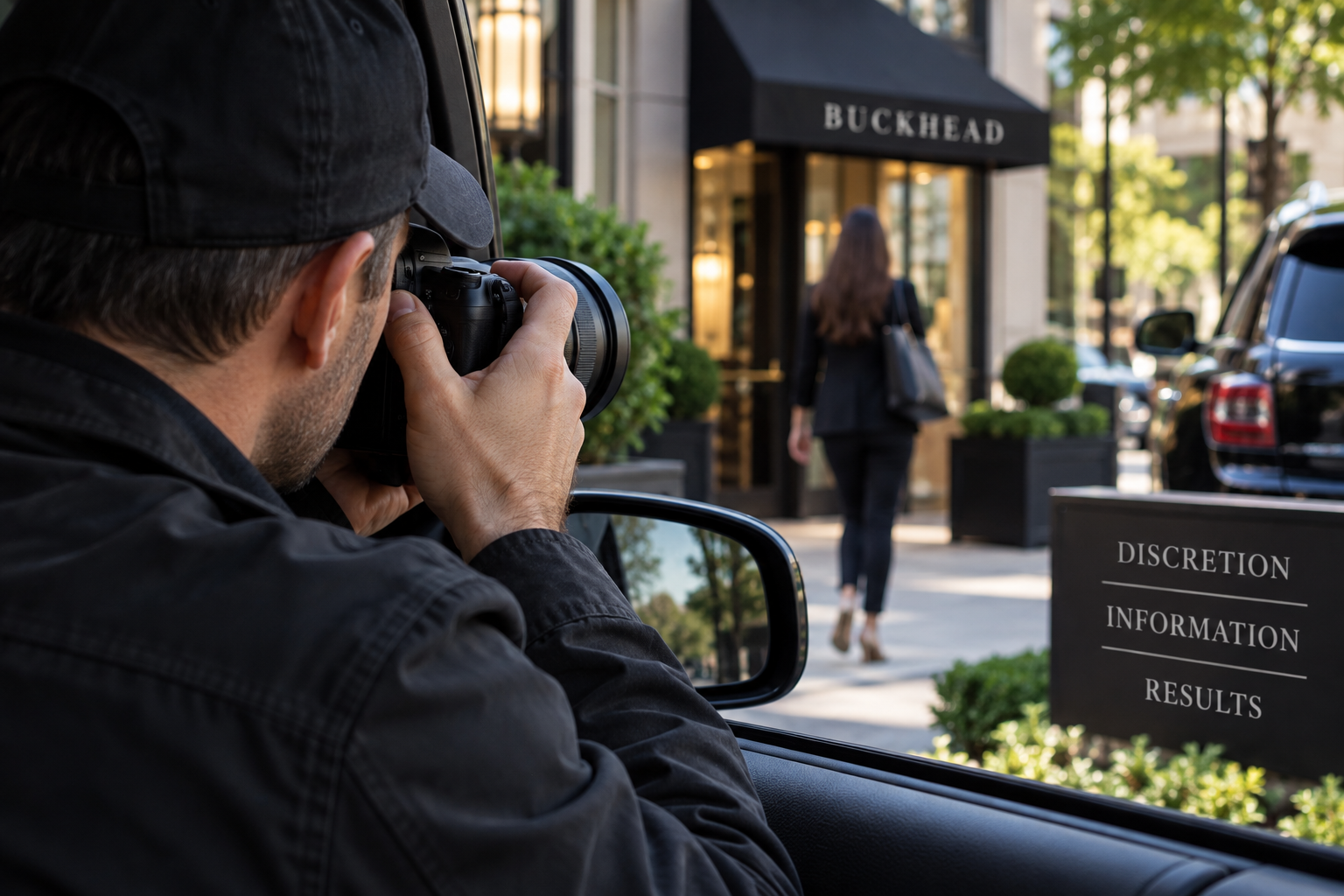
Private investigators may use lawful surveillance, field work, interviews, public record research, or other legal methods to verify what is happening outside the internet. This is especially relevant in infidelity, custody, missing person, witness location, and fraud-related matters.
Buckhead Private Investigator’s article on discreet surveillance services in Buckhead explains why professional surveillance is about lawful observation and documentation, not guesswork or harassment.
A Private Investigator Can Document Findings Professionally
Finding information is only part of the job. Documentation is another major difference between a private investigator and a DIY search.
A person doing their own online search may save screenshots, write down notes, or bookmark pages. That can be helpful, but it may not be organized in a way that is useful for an attorney, court, business decision, or personal records.
A private investigator can prepare reports, timelines, summaries, photographs, video documentation, public record findings, and observations in a more structured format. This can help clients understand what was found, when it was found, how it was documented, and why it matters.
Professional documentation can be especially important in legal-related cases. Buckhead Private Investigator’s guide on how private investigators document evidence for court explains why organized reporting, clear timelines, and lawful collection methods matter.
Not every finding becomes court evidence. That decision belongs to the attorney and the court. But proper documentation can make information easier to evaluate.
Investigators Understand Legal Limits
One of the most important things a private investigator brings is an understanding of legal boundaries. Online advice often makes investigation sound simple, but many methods people suggest online are illegal, unethical, or dangerous.
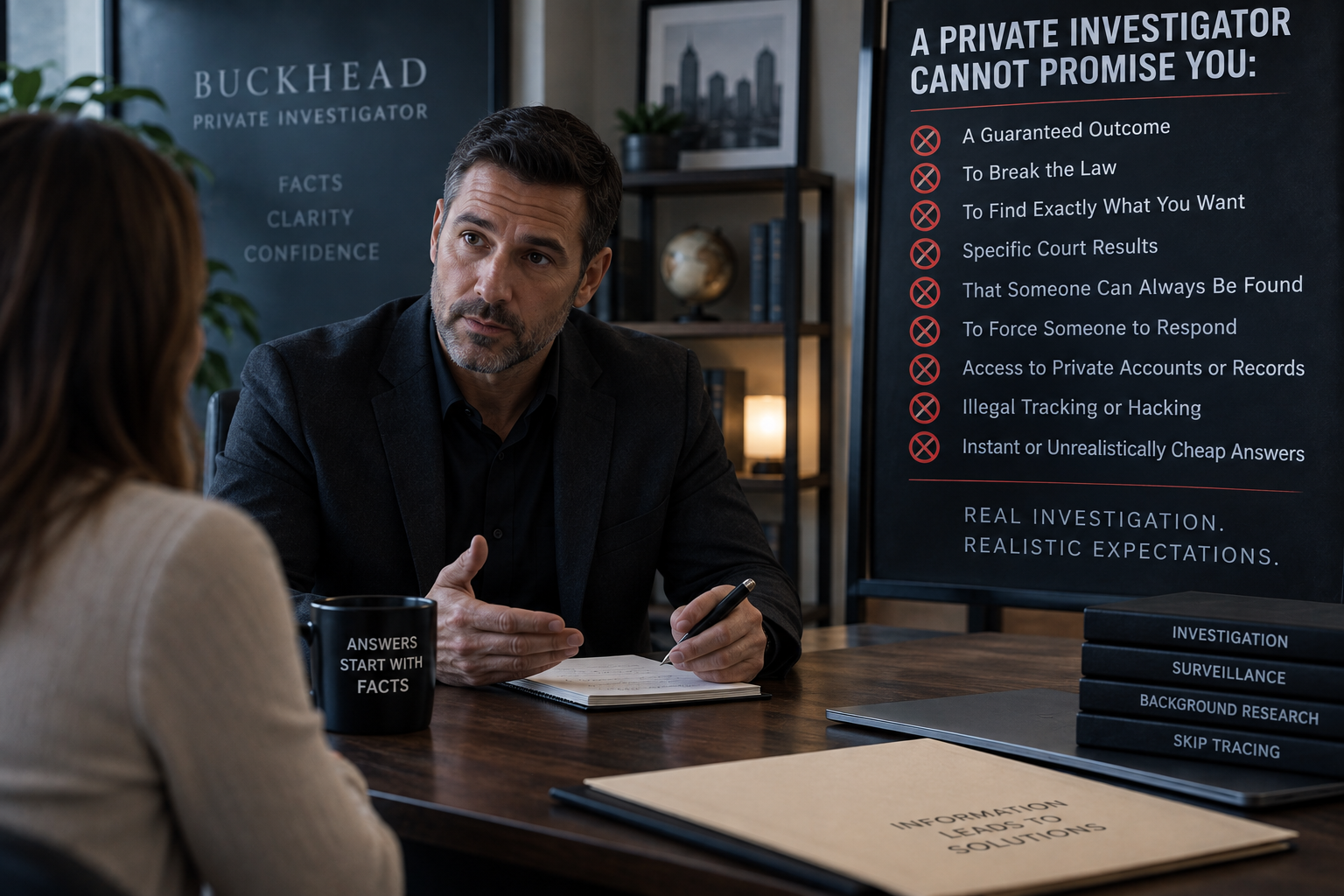
A private investigator cannot hack accounts, break into email, access private phones, trespass, impersonate law enforcement, illegally record private conversations, or place illegal tracking devices. In Georgia, private detective businesses are regulated through the Georgia Board of Private Detective and Security Agencies. The Georgia Secretary of State explains that private detective company licenses are issued to companies and provides information about license verification and requirements.
This matters because information gathered illegally may create more problems than it solves. It can also put the client at risk.
If you are unsure what a private investigator can legally do, Buckhead Private Investigator’s article on whether it is legal to hire a private investigator in Georgia is a helpful starting point. Their guide on whether a private investigator can legally follow someone in Georgia also explains why lawful surveillance must stay within clear boundaries.
DIY Searching Can Escalate a Sensitive Situation
People often start searching online because they are worried, suspicious, or under pressure. That is understandable. But DIY investigation can sometimes make the situation worse.
A person may accidentally alert the subject by viewing profiles, contacting mutual connections, sending messages, confronting someone too early, or making accusations based on incomplete information. They may also collect information in a way that is not useful or creates privacy concerns.
In personal cases, such as infidelity, divorce, custody, or family disputes, emotions can run high. A private investigator provides distance. They can focus on facts, documentation, and lawful methods instead of emotional reaction.
For example, if someone suspects infidelity, a professional investigator can help determine whether there are observable patterns rather than relying only on assumptions. Buckhead Private Investigator’s article on what proof a private investigator can gather for infidelity explains how documentation may help clarify concerns while staying within legal limits.
Hidden Social Media Accounts Are Not Always Easy to Find
Many people assume social media research is simple. Search a name, check a few platforms, and you are done. In reality, people may use nicknames, alternate spellings, old usernames, private profiles, secondary accounts, business pages, or accounts connected to email addresses and phone numbers that are not publicly visible.
An online search may find the obvious profiles but miss the accounts that matter. It may also misidentify someone else’s account as the subject’s account.
A private investigator can review public-facing online information more carefully. They may compare usernames, photos, relationships, locations, posting patterns, business names, and other lawful indicators. The goal is not to hack or bypass privacy settings. The goal is to identify and document public information accurately.
Buckhead Private Investigator’s guide on whether a private investigator can find hidden social media accounts explains what may be possible through lawful online research.
Address Searches Can Be Misleading
Finding an address online is one of the most common DIY investigation attempts. Unfortunately, online address results are often unreliable. Data broker sites may show old addresses, relatives’ addresses, mailing addresses, business addresses, or locations connected to someone years ago.
If the goal is to locate someone, serve legal documents, find a witness, or verify where someone currently lives, accuracy matters. A wrong address can waste time and money.
A private investigator can use skip tracing, public records, database research, and verification methods to determine whether an address appears current. They may also look for patterns that support or contradict a listed location.
Buckhead Private Investigator’s article on whether a private investigator can find someone’s current address explains why current address research is more complex than typing a name into a search engine.
Professional Investigators Can Help Locate People
Online searches may fail when someone has moved, changed phone numbers, stopped posting publicly, avoided contact, or left a limited digital footprint. This is where skip tracing and professional location work can help.
Skip tracing may be used to locate witnesses, missing persons, debtors, former tenants, family members, or individuals connected to legal matters. It involves comparing multiple sources and looking for current, reliable contact or location information.
Buckhead Private Investigator’s guide on what skip tracing is and how it helps locate people explains how this process differs from basic online searching.
Again, legal purpose matters. A reputable investigator should ask why you are trying to locate someone and should not assist with stalking, harassment, threats, or unlawful conduct.
Background Checks Need More Than a Search Engine
Background research is another area where online searches often miss key details. A search engine may find social media profiles, news articles, or general directory listings, but it may not provide a complete or accurate view.
A professional background check may involve public records, civil filings, criminal records where legally available, business records, professional licenses, address history, litigation history, and other lawful sources. The investigator can also help distinguish between confirmed information and unverified data.
This can be useful before a business partnership, sensitive hire, relationship decision, custody concern, or legal matter. However, there are legal limits around how background information can be used, especially for employment, tenant screening, credit, or other regulated purposes.
Buckhead Private Investigator’s article on background checks in Buckhead and what a private investigator can legally find explains why professional background research requires both access and judgment.
A Private Investigator Can Connect the Dots
Perhaps the biggest difference between online searching and private investigation is context. Online searches produce fragments. A private investigator looks for patterns.
One record may show an old address. Another may show a business connection. Another may show a court filing. Another may show a social media alias. One observation may confirm or contradict the online trail. Separately, each detail may not mean much. Together, they may create a clearer picture.
This is especially valuable in complicated cases. A person may use different names, outdated addresses, hidden profiles, business entities, or inconsistent statements. A private investigator can compare details and build a more organized timeline.
That kind of analysis is difficult to get from search results alone.
When an Online Search May Be Enough
It is also important to be realistic. Not every question requires a private investigator. If you only need a business phone number, a company website, a public address for a government office, or basic information that is easy to verify, an online search may be enough.
A private investigator becomes more useful when the information is sensitive, disputed, incomplete, hard to verify, connected to a legal matter, or likely to affect an important decision.
If you are unsure whether you need help, a consultation can clarify what is realistic. Buckhead Private Investigator’s article on how long a private investigation usually takes can help set expectations about timing and scope.
Final Thoughts
An online search can be a helpful starting point, but it is not the same as a professional investigation. Search engines often miss key details, show outdated records, confuse people with similar names, and provide information without context.
A private investigator can do what an online search cannot: verify information, interpret public records, document findings, conduct lawful surveillance when appropriate, locate people through skip tracing, identify patterns, and understand legal limits.
For clients in Buckhead and the Atlanta area, this can matter in sensitive cases involving divorce, infidelity, custody, missing persons, witness location, background research, social media concerns, or business due diligence. The goal is not to gather random information. The goal is to find accurate, lawful, relevant details that help you make informed decisions.
If a basic online search has left you with more questions than answers, working with a licensed private investigator may help you move from uncertainty to documented facts.