Social media can reveal a lot about a person’s activities, relationships, interests, location patterns, business connections, and public behavior. In many private investigation cases, online activity becomes an important part of the bigger picture. A hidden or unknown social media account may matter in an infidelity case, custody concern, background check, missing person search, business dispute, or legal investigation.
So, can a private investigator find hidden social media accounts?
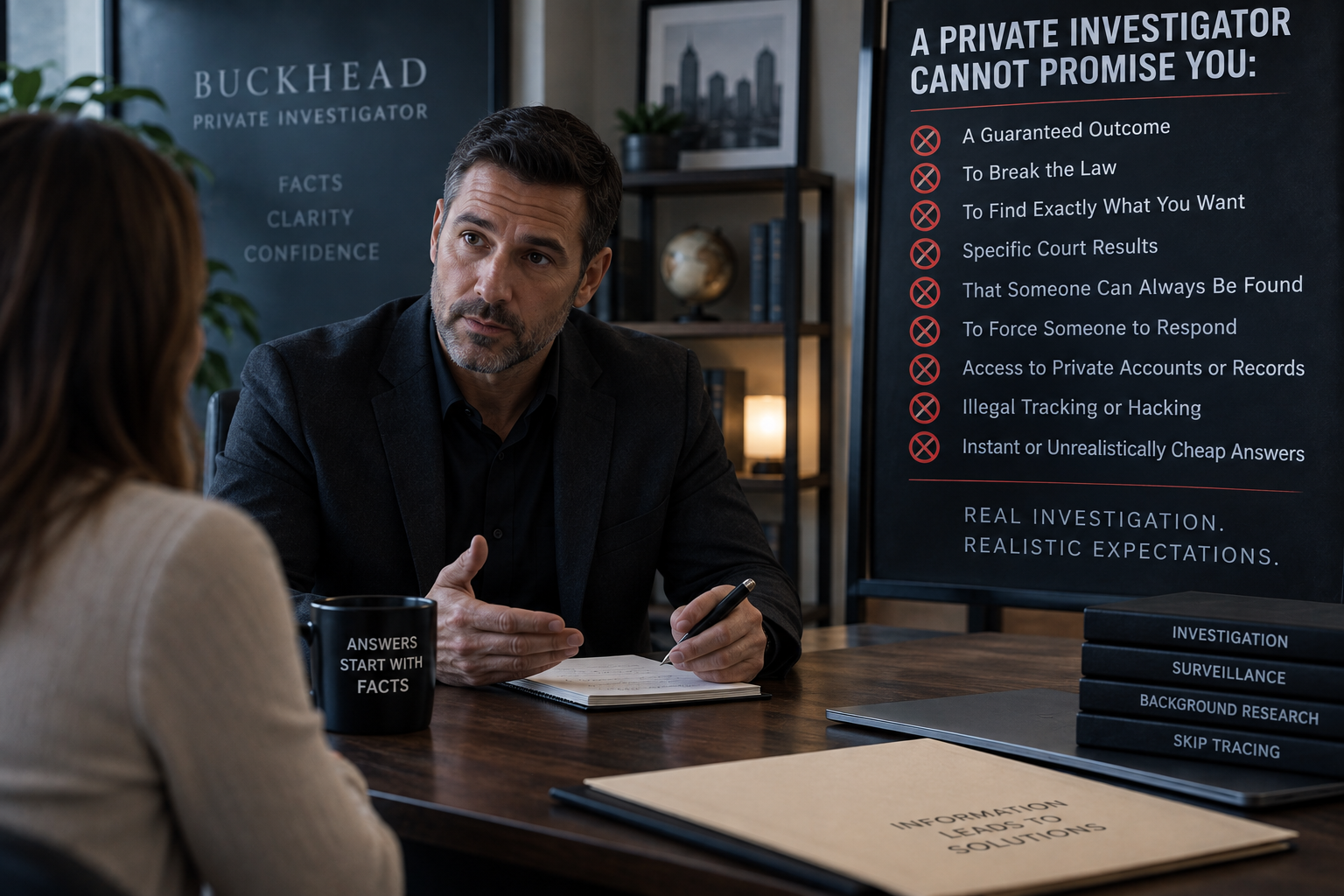
In many cases, a private investigator may be able to identify social media profiles that are publicly available, connected to known usernames, tied to aliases, associated with email patterns, linked through friends or relatives, or visible through open-source research. However, there are strict limits. A private investigator cannot hack accounts, break into private messages, bypass passwords, impersonate someone, install spyware, or use illegal methods to access private social media activity.
For clients in Buckhead, the value of hiring a private investigator is not that they can do anything online. The value is that they know how to search, verify, document, and interpret online information lawfully. Hidden social media research is not about illegal access. It is about finding public or legally obtainable information that may help clarify the situation.
If you are new to investigative services, it may help to start with what a private investigator in Buckhead actually does.
What Counts as a Hidden Social Media Account?
A hidden social media account does not always mean a secret account used for wrongdoing. It may simply be an account that is not easy to find through a basic name search.
A person may use a nickname, middle name, maiden name, alternate spelling, old username, business name, hobby-related handle, anonymous profile, or account connected to a different phone number or email address. They may have separate accounts for personal use, dating, business, gaming, investing, fitness, travel, or private groups.
Some people also keep social media accounts hidden because they want privacy. Others may use hidden accounts to communicate with someone secretly, conceal activities, misrepresent their lifestyle, avoid legal responsibility, or hide behavior relevant to a case.
A private investigator’s job is not to assume the reason. Their job is to research, verify, and document what can be found legally.
How Private Investigators Search for Social Media Accounts
A private investigator may use open-source intelligence, often called OSINT, to search for online accounts. This means reviewing publicly available information from social platforms, search engines, websites, public records, business listings, archived pages, usernames, images, and other legal sources.
The investigator may begin with basic identifying information such as name, age, location, known email addresses, phone numbers, relatives, employers, schools, businesses, nicknames, or aliases. From there, they may look for connections across platforms.
For example, someone may use the same username on Instagram, TikTok, Facebook, X, Reddit, LinkedIn, YouTube, Pinterest, or dating-related platforms. A profile photo may appear on multiple sites. A business page may link to a personal account. A relative’s public account may tag or mention the person. A public comment may reveal a username that does not appear in a normal search.
The process often requires patience and verification. A single username match does not prove the account belongs to the person. A professional investigator looks for multiple supporting details before connecting an account to a subject.
What Information Can Social Media Reveal?
Public social media activity may reveal information such as location clues, relationships, travel patterns, business activity, lifestyle, photos, videos, comments, public groups, tagged posts, friends, followers, interests, events, and timelines.
In an infidelity investigation, public posts or tagged content may show social connections, outings, or inconsistencies in someone’s schedule. In a custody matter, social media may show lifestyle concerns, travel, unsafe behavior, or public activity that may be relevant to a parent’s concern. In a business investigation, social media may reveal undisclosed employment, side businesses, conflicts of interest, or false claims. In a missing person case, social accounts may provide recent activity or connections.
However, social media can also be misleading. Posts can be old, staged, exaggerated, edited, or taken out of context. A tagged photo does not always prove where someone was on a certain date. A public comment may not mean a close relationship. A profile may belong to someone with a similar name.
This is why verification matters. For a broader explanation of what investigators may legally find, read What Information Can a Private Investigator Find About Someone?.
Hidden Accounts and Infidelity Cases
Social media often comes up in infidelity investigations. A spouse may have a private Instagram account, a second Facebook profile, a hidden TikTok account, or a username that does not use their real name. They may interact publicly with someone in ways that raise questions, appear in tagged photos, or use online activity to hide part of their life.
A private investigator may search for public profiles, identify possible usernames, review public interactions, document timeline inconsistencies, and combine online research with other lawful investigative methods.
However, an investigator cannot hack into private messages or access password-protected accounts. They cannot pretend to be someone else to manipulate the subject into accepting a connection request if that would be deceptive, improper, or legally risky. They cannot install monitoring software on someone’s phone or computer.
Social media may help guide an investigation, but it should not be the only source of proof. For more on infidelity documentation, read What Proof Can a Private Investigator Gather for Infidelity? and What to Expect When You Hire a Private Investigator for Infidelity.
Hidden Accounts and Child Custody Concerns
In custody matters, social media may provide information about a parent’s lifestyle, travel, supervision, relationships, public behavior, or possible custody agreement violations. For example, public posts may show that a parent was somewhere different than claimed, left a child with another person, traveled during a custody period, or engaged in behavior the other parent believes may be relevant.
That said, custody investigations must be handled carefully. Social media should not be used to harass, intimidate, embarrass, or publicly shame the other parent. It should be documented lawfully and discussed with an attorney if it may become part of a legal case.
A private investigator can help gather and preserve public information, but an attorney can explain whether it matters legally. The court decides custody matters, not the investigator.
For related guidance, read How a Buckhead Private Investigator Helps With Child Custody Cases.
Hidden Accounts and Background Checks
A hidden social media account may also be relevant in background research. Someone may present one version of themselves professionally while using another account for public behavior that raises concerns. This can matter in due diligence, dating-related safety concerns, employee misconduct investigations, business disputes, or legal matters.
Private investigators may use social media research as one part of a broader background check. They may compare public records, aliases, business affiliations, court records, address history, and online activity to build a more complete picture.
However, background checks must be handled legally and responsibly. Depending on the purpose, certain laws and consent requirements may apply, especially for employment, housing, credit, or other regulated decisions. A private investigator should be clear about what kind of background research is being requested and why.
For more on this, read Background Checks in Buckhead: What a Private Investigator Can Legally Find.
Hidden Accounts and Missing Person Searches
Social media can be useful when trying to locate someone who has gone missing, stopped communicating, or become difficult to reach. A hidden or secondary account may show recent activity, location clues, friends, associates, workplaces, interests, or travel patterns.
A private investigator may review public posts, tagged photos, follower connections, old usernames, groups, and online interactions to identify possible leads. This can support skip tracing, address research, witness location, or missing person investigations.
But missing person work also requires sensitivity. Not everyone wants to be found, and not every situation is safe. If there is a safety concern, law enforcement or an attorney may need to be involved.
For more information, see How Private Investigators Help Locate Missing Persons in Buckhead and What Is Skip Tracing and How Does It Help Locate People?.
What a Private Investigator Cannot Do Online
A private investigator cannot legally access everything online. There are clear limits.
They cannot hack into social media accounts, guess passwords, use stolen login credentials, bypass privacy settings, install spyware, intercept private messages, impersonate law enforcement, access someone’s phone without permission, or break into email accounts.
They also should not use social media research to help a client stalk, harass, threaten, intimidate, or repeatedly contact someone. Georgia’s stalking statute includes contacting another person through a computer, computer network, or electronic device when done for the purpose of harassing and intimidating. Georgia law defines stalking in part as following, placing under surveillance, or contacting another person without consent for the purpose of harassing and intimidating them.
Georgia law also restricts certain forms of secret eavesdropping, private surveillance, and interception of private communications. Georgia Code § 16-11-62 addresses illegal eavesdropping or surveillance, including secretly intercepting private communications and recording private activity in certain places.
A reputable investigator will explain these limits. If someone promises to hack an account, recover private messages without consent, or secretly monitor a person’s device, that is a major red flag.
How Investigators Document Social Media Evidence
Finding a hidden social media account is only part of the work. Documentation matters, especially if the information may be used in a legal matter.
A private investigator may document the profile name, username, URL, visible bio details, profile image, date and time of review, relevant posts, screenshots, captions, comments, tagged content, follower connections, and how the account appears connected to the subject.
Context matters. A screenshot without a date, source, or explanation may be weak. A documented timeline with multiple supporting details is more useful.
Online content can disappear quickly. Posts may be deleted, accounts may be changed, and usernames may be updated. Preserving information properly can help attorneys or clients evaluate it later.
For more on evidence documentation, read How Private Investigators Document Evidence for Court.
Why Professional Verification Matters
Many people try to find hidden accounts on their own. Sometimes they are right. Other times, they connect the wrong account to the wrong person. This can create confusion, conflict, or legal problems.
A private investigator helps reduce that risk by verifying information across multiple sources. They may look for matching photos, usernames, locations, relatives, employment details, friend networks, public records, and timeline consistency.
The goal is not to jump to conclusions. The goal is to determine whether the account is likely connected to the correct person and whether the information is relevant to the client’s concern.
This is especially important in court-related matters. An attorney needs reliable information, not assumptions.
Why Licensing and Ethics Matter
Social media investigations can become invasive if handled improperly. That is why licensing, ethics, and professionalism matter.
Georgia private detective and security agencies are regulated through the Georgia Secretary of State’s Board of Private Detective and Security Agencies, which provides licensing, renewal, and board information for the profession.
A licensed private investigator should understand legal boundaries, confidentiality, documentation, and responsible research practices. They should not encourage illegal access or unsafe behavior.
If you are considering help with a sensitive online concern, you can learn more through the About page or reach out through Contact Us.
Final Thoughts
A private investigator may be able to find hidden social media accounts through lawful open-source research, username searches, public records, tagged content, online connections, aliases, and careful verification. These accounts may be relevant in infidelity cases, custody concerns, background checks, missing person searches, business disputes, and legal matters.
However, there are limits. A private investigator cannot hack accounts, bypass privacy settings, access private messages illegally, install spyware, or help a client stalk or harass someone. Social media research must be lawful, ethical, and tied to a legitimate purpose.
For clients in Buckhead, hiring a private investigator can help turn scattered online clues into clearer, better-documented information. The right investigator can search carefully, verify findings, preserve evidence, and explain what the information may show without crossing legal lines.