A witness can be important to a legal case, insurance matter, business dispute, family law issue, or personal injury claim. But what happens when that person cannot be found? They may have moved, changed phone numbers, stopped responding, left a job, avoided contact, or become difficult to reach after time has passed.
That is where a witness locate investigation may help.
A witness locate investigation is the process of finding and verifying contact information for someone who may have relevant knowledge about a case or situation. The goal is not to pressure, threaten, or force the person to participate. The goal is to identify where they may be located, confirm whether the information is current, and help attorneys, process servers, insurance professionals, or clients take the next lawful step.
For legal matters in Georgia, locating a witness may be important because subpoenas can be used to command a person to attend and give testimony or produce evidence at a specified time and place. Georgia law defines a subpoena as including both a witness subpoena and a subpoena for production of evidence. (law.justia.com)
A private investigator may help with the fact-finding and locate portion, but attorneys and courts determine how the witness is contacted, subpoenaed, or used in the case.
Why a Witness May Need to Be Located
Witness locate investigations are common when someone has information that may help clarify facts. The witness may have seen an accident, heard a conversation, worked with a party, lived near an incident, interacted with a business, observed behavior, or been listed in a police report, contract, text message, or court filing.
Sometimes the witness is cooperative but hard to find. Other times, they may not know they are needed. In some cases, the witness may be avoiding contact, worried about involvement, or unsure whether they should speak.
Common situations that may require witness location include civil lawsuits, personal injury claims, divorce disputes, child custody concerns, business disagreements, employment matters, insurance claims, property disputes, criminal defense support, and service of process issues.
Buckhead PI’s article on Can a Private Investigator Help Find a Witness in Georgia? is a helpful related resource if you are trying to understand when a witness search may be useful.
A Witness Locate Is Not the Same as a Witness Interview
Finding a witness and interviewing a witness are different steps. A witness locate investigation focuses on identifying current contact information, address history, possible phone numbers, workplace information, relatives, public records, or other leads that may help confirm where the person can be reached.
A witness interview, on the other hand, involves asking the person what they know. That may be handled by an attorney, investigator, insurance professional, or another authorized person depending on the case.
A private investigator may help locate the witness and, when appropriate, document lawful contact attempts or gather preliminary information. However, if the case is active litigation, attorneys often guide how and when witnesses should be contacted.
This distinction matters because finding someone does not mean they are required to talk voluntarily. A witness may choose not to speak unless properly subpoenaed or contacted through legal channels.
How a Private Investigator May Start the Search
A witness locate investigation usually starts with the information already available. That may include a name, old address, phone number, employer, email address, license plate, social media profile, police report, case file, prior statement, or known connection to the parties involved.
The investigator may first verify the basics. Is the name spelled correctly? Is the person still living at the last known address? Are there multiple people with the same name? Is the phone number current? Did the person move out of state? Are there aliases, married names, or business names involved?
From there, the investigator may use public records, database research, address history, social media, employment clues, property records, court records, professional listings, or other lawful sources. The goal is to narrow possibilities and avoid wasting time on outdated or incorrect information.
Buckhead PI’s article on What Information Can a Private Investigator Find About Someone? explains the types of information that may be available through lawful research.
Skip Tracing May Be Part of Witness Location
Skip tracing is often used in witness locate investigations. It involves searching for someone whose current location is unknown or uncertain. The process may include reviewing public records, address databases, phone history, relatives, property ties, employment clues, social media, and other leads.
Skip tracing can be helpful when a witness has moved, stopped responding, changed contact information, or has not been contacted in years. It can also help separate the correct person from others with similar names.
However, skip tracing is not magic. Records can be outdated, incomplete, or connected to the wrong person. A professional investigator can help verify leads rather than relying on a single online search result.
Buckhead PI’s article on What Is Skip Tracing and How Does It Help Locate People? is a strong related read for understanding how this process works.
Address Verification Matters
A witness locate is only useful if the information is accurate. Sending a process server, attorney letter, or investigator to the wrong address wastes time and may delay the case.
Address verification may involve comparing multiple sources, checking whether the person is associated with a residence, confirming whether mail or public records point to the location, identifying recent moves, or observing whether the person appears to use the address.
This is especially important when the witness has a common name, recently moved, uses a family member’s address, or has inconsistent online information.
Buckhead PI’s article on Can a Private Investigator Find Someone’s Current Address? explains why current-address verification can be more complicated than it seems.
Witnesses May Be Needed for Court, Depositions, or Statements
A located witness may be needed for several reasons. They may need to speak with an attorney, provide a statement, appear for a deposition, respond to a subpoena, or testify in court.
In Georgia civil matters, subpoenas may command a person to attend and give testimony or produce evidence at a time and place specified in the subpoena. Georgia law also addresses service of subpoenas, including personal service and certified mail in certain contexts. (law.justia.com)
The investigator’s role is typically to help locate and document, not to decide the legal step. If a subpoena, deposition, or testimony is involved, an attorney should guide the process.
A Witness May Not Want to Be Found
Some witnesses avoid involvement because they do not want conflict, fear retaliation, do not understand why they are needed, or simply do not want to be part of a legal matter. Others may avoid contact because they have personal ties to one side.
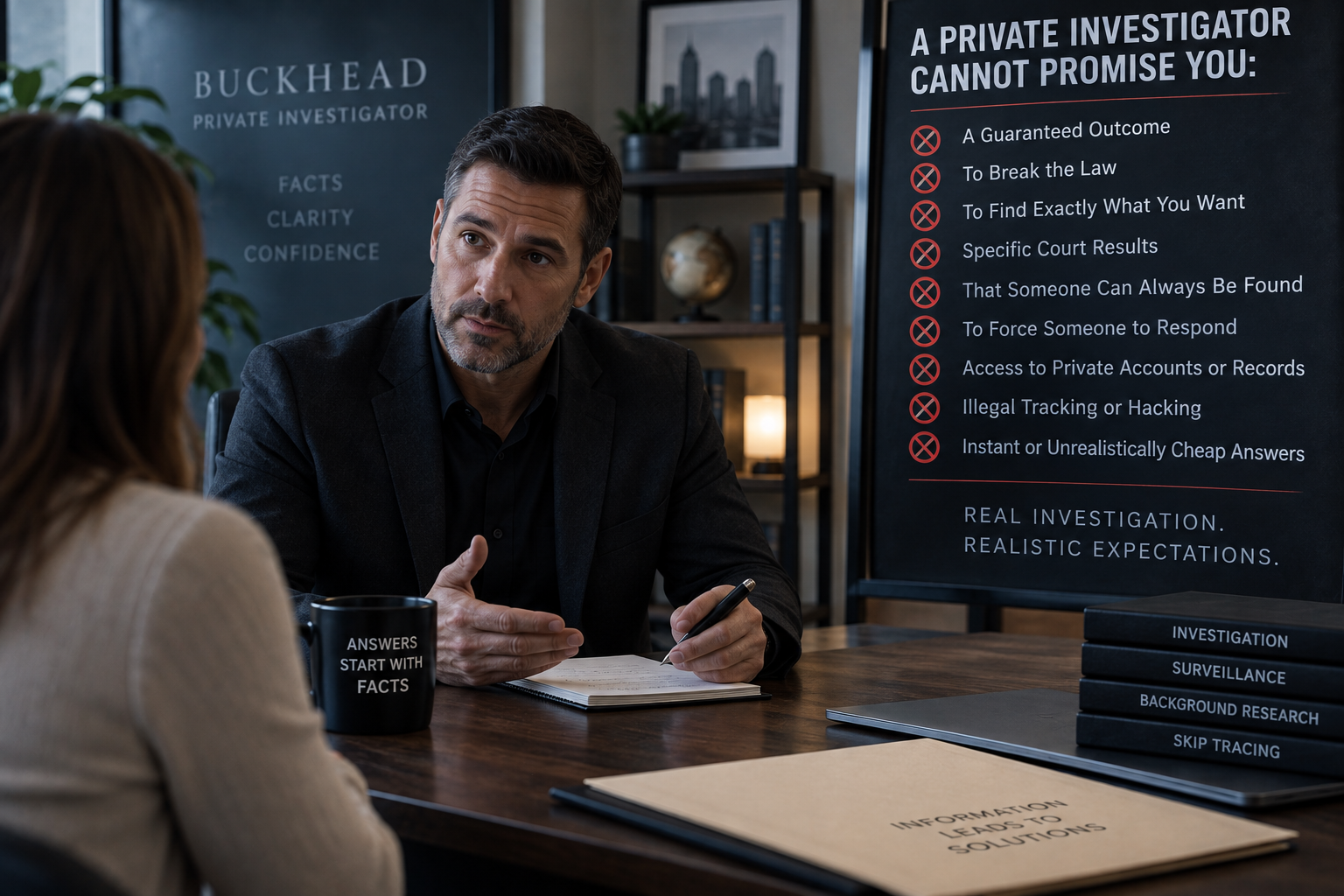
A private investigator still has to work within legal boundaries. They cannot harass, threaten, impersonate law enforcement, trespass, hack accounts, or force a person to communicate. They also cannot guarantee that a witness will cooperate.
A successful witness locate may simply confirm where the person can be found or served. Whether the witness speaks voluntarily, appears for testimony, or provides a statement depends on the legal process and the person’s obligations.
Buckhead PI’s article on What a Private Investigator Cannot Promise You explains why no investigator should promise cooperation or a specific outcome.
Witness Locate Investigations Can Support Attorneys
Attorneys often need reliable witness information to move a case forward. A witness may be listed in old records, mentioned by a client, referenced in police reports, or identified during discovery. If that person cannot be found, the attorney may need investigative support.
A private investigator can help by locating the witness, verifying contact details, documenting search efforts, identifying possible addresses, and providing organized reports. This can help attorneys decide whether to pursue a statement, subpoena, deposition, or other legal step.
Buckhead PI’s article on How Private Investigators Document Evidence for Court explains why organized documentation can be valuable when facts may later be reviewed in a legal setting.
Witness Locate Investigations Can Help With Service of Process
Sometimes a witness locate overlaps with service of process. If someone needs to be served with a subpoena, court papers, or legal notice, locating them accurately may be the first step.
This is especially important when a person has moved, avoids contact, or has multiple possible addresses. A private investigator may help verify where the person is likely to be found. A process server may then attempt service according to the applicable rules.
Buckhead PI’s article on What to Do If You Need to Serve Someone Who Is Avoiding Papers explains how locate work and process service can fit together.
Witness Locate Investigations Can Help in Civil Disputes
Civil disputes often depend on what people saw, heard, received, signed, witnessed, or understood. A witness might have information about a contract, transaction, property damage, workplace incident, business disagreement, accident, or conversation.
In business disputes, a witness might be a former employee, customer, contractor, vendor, tenant, neighbor, bookkeeper, or third-party observer. Locating that person may help attorneys understand what evidence exists.
Buckhead PI’s article on When Does a Business Dispute Call for a Private Investigator? explains how fact-finding can support business-related legal concerns.
Witness Locate Investigations Can Help in Family Law Matters
Family law cases may involve witnesses who can speak to routines, living arrangements, custody exchanges, concerning behavior, parenting patterns, cohabitation concerns, or other disputed facts.
A witness might be a neighbor, caregiver, teacher, family friend, former partner, landlord, employer, or someone else with relevant information. Locating that witness may help an attorney determine whether their information is useful.
Buckhead PI’s article on How a Buckhead Private Investigator Helps With Child Custody Cases is relevant when witness information may connect to custody documentation.
What Information Helps a Witness Locate Investigation?
The more accurate starting information you provide, the better. Before contacting a private investigator, gather details such as:
Full name
Known aliases or maiden names
Date of birth or approximate age
Last known address
Old phone numbers or emails
Employer or former employer
Social media profiles
Vehicle information
Known relatives or associates
Connection to the case
Date and location of the incident
Any prior statements
Documents where the witness is mentioned
Attorney instructions or case deadlines
Do not worry if you do not have everything. A private investigator may still be able to work with limited details. But the more specific the starting point, the more focused the search can be.
What a Witness Locate Report May Include
A witness locate report may include confirmed or possible addresses, phone numbers, employment leads, related names, public record findings, social media clues, observation notes, dates of search activity, and confidence levels for different leads.
A good report should separate confirmed facts from possible leads. It should not overstate what is known. For example, an address connected to a person five years ago should not be treated the same as a current verified residence.
This is one reason professional documentation matters. An attorney or process server may need to understand which information is strongest and which still needs confirmation.
Buckhead PI’s article on What Is Considered Legal Evidence in a Private Investigation? explains why how information is gathered and documented can matter.
What a Private Investigator Cannot Do in a Witness Locate
A private investigator cannot force a witness to speak, appear, testify, or take your side. They cannot threaten, harass, trespass, impersonate officials, hack private accounts, access protected records without authorization, or use illegal surveillance methods.
They also cannot give legal advice about whether a witness is material, whether a subpoena should be issued, or how the witness should be used in court. Those questions belong to an attorney.
A PI can help gather facts, verify location information, and document search efforts. That support may be valuable, but it still has limits.
When to Start a Witness Locate Investigation
It is usually better to start early. Witnesses may move, forget details, change phone numbers, delete social media, become harder to locate, or become less willing to engage as time passes. Legal deadlines may also create urgency.
If a witness may be important to a case, do not wait until the week before a hearing. Give the investigator and attorney enough time to locate, verify, and decide next steps.
Buckhead PI’s article on How Long Does a Private Investigation Usually Take? explains why timelines depend on the quality of starting information, the person’s location, and the complexity of the case.
Final Thoughts
A witness locate investigation is a focused effort to find and verify contact or location information for someone who may have relevant knowledge about a legal, personal, insurance, or business matter. It may involve skip tracing, public records, address verification, social media research, employment clues, and lawful documentation.
A private investigator can help identify where a witness may be found, but they cannot force cooperation, guarantee testimony, or replace legal counsel. If the witness is needed for court, deposition, or subpoena, an attorney should guide the legal process.
If you need to locate a witness in Buckhead, Atlanta, or elsewhere in Georgia, contact Buckhead Private Investigator for discreet, lawful witness locate support.