Business disputes can start quietly. A partner stops communicating clearly. A vendor’s story does not add up. Money moves in unexpected ways. A former employee appears to be violating an agreement. A contractor disappears before completing work. A business associate claims they are unable to pay, but their activity suggests otherwise.
Not every business disagreement requires a private investigator. Some issues can be handled through direct communication, contracts, accounting records, attorneys, or normal business processes. But when facts are unclear, information is missing, or someone may be hiding something, a private investigator can help bring structure to the situation.
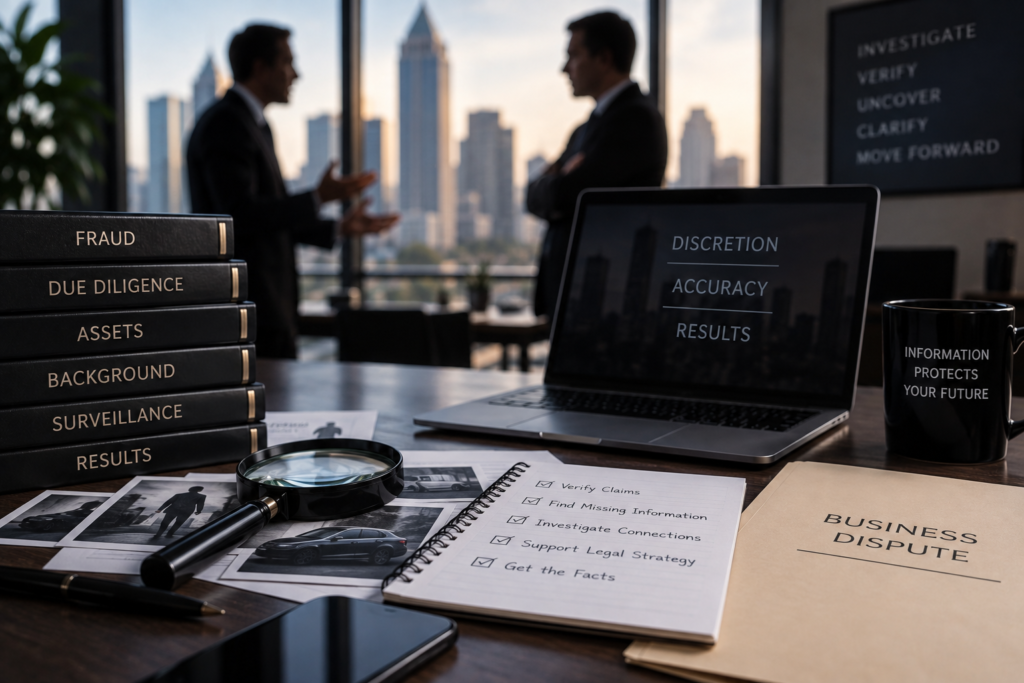
A private investigator does not replace an attorney, accountant, or court process. Instead, a PI can help gather factual information, locate people, document activity, verify claims, identify connections, and support a legal or business strategy with clearer evidence.
For business owners, executives, investors, landlords, contractors, and professionals in Buckhead, discretion matters. A business dispute can affect money, reputation, client relationships, partnerships, and future opportunities. If you need facts before taking your next step, Buckhead Private Investigator can help evaluate whether background research, surveillance, skip tracing, or another investigative method may be appropriate.
When the Other Party’s Story Does Not Add Up
One of the clearest signs a business dispute may call for a private investigator is when someone’s story keeps changing. A business partner may give different explanations about missing funds. A vendor may claim supplies were delayed, then later say payment was never received. A contractor may say they are still operating, but their business appears inactive. A client may claim financial hardship while continuing other expensive activity.
Inconsistent stories do not automatically prove wrongdoing. But they can create enough concern to justify verification.
A private investigator can help compare claims against available facts. That may involve reviewing public records, business registrations, address history, employment indicators, online activity, court records, property information, or other legally available sources.
The goal is not to assume guilt. The goal is to determine whether the person’s claims match what can be verified.
Buckhead Private Investigator’s article on what information a private investigator can find about someone explains how legally available information can help clarify confusing situations.
When You Need to Verify Business Ties
Business disputes often involve hidden or unclear relationships. Someone may claim they are no longer connected to a company, but records suggest otherwise. A partner may be involved with a competing business. A vendor may have undisclosed ownership connections. A person may use multiple companies, aliases, or addresses to make business activity harder to follow.
In these situations, a private investigator may help identify business affiliations, registered entities, addresses, professional connections, public filings, and other ties that may matter.
This can be useful in partnership disputes, vendor conflicts, employment concerns, investment disagreements, contract issues, and divorce-related business matters.
Buckhead Private Investigator’s article on whether a private investigator can help confirm someone’s employment or business ties covers this topic in more detail.
When Money Is Missing or Misused
Money-related disputes are one of the most common reasons business owners seek investigative help. Concerns may include missing payments, suspicious transfers, unpaid debts, hidden income, inflated expenses, misuse of company funds, side deals, or inconsistent financial claims.
A private investigator is not a forensic accountant, but a PI may help gather outside facts that support a larger financial review. For example, an investigator may identify business ownership links, address history, litigation, public records, property connections, employment activity, or signs that someone’s claimed financial situation does not match available information.
If the dispute involves formal financial review, your attorney or accountant may need to be involved. A private investigator can support that process by locating people, verifying background information, or documenting activity that may be relevant.
If the concern is related to divorce or hidden assets, Buckhead Private Investigator’s guide on signs your spouse may be hiding assets during divorce may also be relevant, especially when personal and business finances overlap.
When a Business Partner May Be Acting Against the Company
Partnership disputes can become complicated quickly. A partner may be accused of diverting clients, hiding income, working with a competitor, misusing company resources, forming a separate business, or making decisions without consent.
These situations can be emotional because they often involve trust. But before making accusations, it is important to gather facts.
A private investigator may help identify whether a partner has outside business interests, public-facing activity, suspicious affiliations, undisclosed addresses, or patterns that require further review. If there is a need to document observable behavior, surveillance may be considered within legal limits.
However, business owners should involve an attorney before taking major action. Contracts, operating agreements, employment laws, privacy laws, and business obligations can all matter. A PI can help gather facts, but an attorney can explain how those facts should be used.
When You Need to Locate Someone Connected to the Dispute
Sometimes the main problem is that someone cannot be found. A former business partner disappears. A contractor stops responding. A witness moves. A debtor changes addresses. A vendor closes one business and appears under another name. A person connected to a legal claim becomes difficult to reach.
In these cases, skip tracing may be useful. Skip tracing is the process of using legally available records and investigative methods to locate someone whose current whereabouts are uncertain.
A private investigator may use names, aliases, phone numbers, email addresses, old addresses, business records, public records, known associates, and other details to identify current leads.
Buckhead Private Investigator’s guide on what to do if you need to find someone for legal or personal reasons explains how this process may work. The article on what is skip tracing and how does it help locate people is another helpful resource.
When a Witness Matters to the Case
Business disputes may involve witnesses. A former employee may know what happened. A vendor may have seen a transaction. A customer may have relevant communication. A contractor, subcontractor, office manager, bookkeeper, or business associate may have information that helps clarify the dispute.
If the witness cannot be reached, has moved, or is difficult to identify, a private investigator may help locate them. Depending on the situation and legal strategy, an investigator may also assist with documenting contact information or gathering factual statements.
Witness location can be especially important when a dispute becomes legal. Memories fade, people move, and records become harder to track over time.
Buckhead Private Investigator’s article on whether a private investigator can help find a witness in Georgia explains why professional help may be useful when a witness is important.
When Surveillance May Be Needed
Surveillance is not always appropriate for a business dispute, but it can be useful when observable behavior matters. For example, a private investigator may be hired to document whether someone is working at a location they denied, meeting with certain parties, visiting a competing business, using company property, or engaging in activity related to the dispute.
Surveillance must be conducted legally and discreetly. A private investigator cannot trespass, enter private spaces, harass someone, or violate privacy laws. The goal is to observe and document activity from lawful locations.
Business owners should not attempt surveillance on their own. Following someone, showing up at their workplace, contacting their associates, or confronting them can create legal and safety concerns. It can also damage the dispute strategy.
Buckhead Private Investigator’s article on what happens during a surveillance investigation explains how surveillance is planned, documented, and handled professionally.
When You Suspect Fraud or Misrepresentation
Business disputes can involve alleged fraud or misrepresentation. Someone may have lied about their qualifications, business history, identity, ownership, financial condition, licensing, professional experience, or ability to perform the work they promised.
A private investigator can help verify background details and identify inconsistencies. This may include public record research, business history, court records, address history, social media review, corporate filings, or other available information.
For example, if someone claimed to own a successful company, a PI may help determine whether that company exists, where it is registered, who is connected to it, and whether public information supports the claim.
This type of research can help business owners avoid making decisions based on incomplete or false information.
When Online Information Is Suspicious
Some business disputes begin online. A person may use a false name, create misleading profiles, hide business connections, operate through multiple accounts, or present themselves differently across platforms.
A private investigator may help review public-facing online activity, social media profiles, business listings, usernames, websites, reviews, professional profiles, and other digital clues. Online research can sometimes reveal connections, inconsistencies, hidden affiliations, or patterns that are not obvious through a simple search.
However, online investigation has legal limits. A PI should not hack accounts, impersonate someone, access private information illegally, or use deceptive tactics that create risk.
Buckhead Private Investigator’s article on whether a private investigator can find hidden social media accounts explains how online research may support an investigation when handled appropriately.
When You Need Evidence That Can Be Organized Clearly
In a business dispute, scattered information can be hard to use. You may have screenshots, emails, texts, invoices, notes, names, dates, and suspicions, but no clear timeline.
A private investigator can help organize findings into a factual report. That report may include dates, times, public record findings, observed activity, locations, photos, documents, or other relevant information depending on the case.
Clear documentation can help an attorney evaluate the situation, support negotiations, prepare for litigation, or decide whether additional steps are needed.
Buckhead Private Investigator’s article on how private investigators document evidence for court explains why organized reporting matters.
When You Need Discretion
Business disputes can be sensitive. If word spreads too early, it can damage relationships, alert the other party, affect employees, harm reputation, or make the person harder to locate.
A private investigator can help gather information quietly. Discretion is especially important in Buckhead, where professional reputation, privacy, and business relationships may carry significant weight.
If the other party learns they are being looked into too soon, they may change behavior, delete public-facing information, move assets, adjust routines, stop communicating, or become more difficult to investigate.
Buckhead Private Investigator’s article on why discretion matters when hiring a private investigator in Buckhead explains why quiet handling can protect the integrity of the investigation.
When You Should Involve an Attorney First
If the dispute involves contracts, litigation, partnership agreements, employment issues, debt collection, fraud allegations, divorce, custody, or potential court use, speak with an attorney before starting an investigation.
An attorney can help define what information matters, what methods are appropriate, and how findings should be used. In some cases, an attorney may hire the investigator directly to support legal strategy.
A PI can gather facts, but they cannot provide legal advice. The best approach is often a coordinated one: the attorney identifies the legal relevance, and the investigator helps gather information within that scope.
Buckhead Private Investigator’s guide on what is considered legal evidence in a private investigation is a useful starting point for understanding why legally gathered information matters.
What a Private Investigator Cannot Do
A private investigator cannot do anything simply because the client wants answers. There are legal and ethical limits.
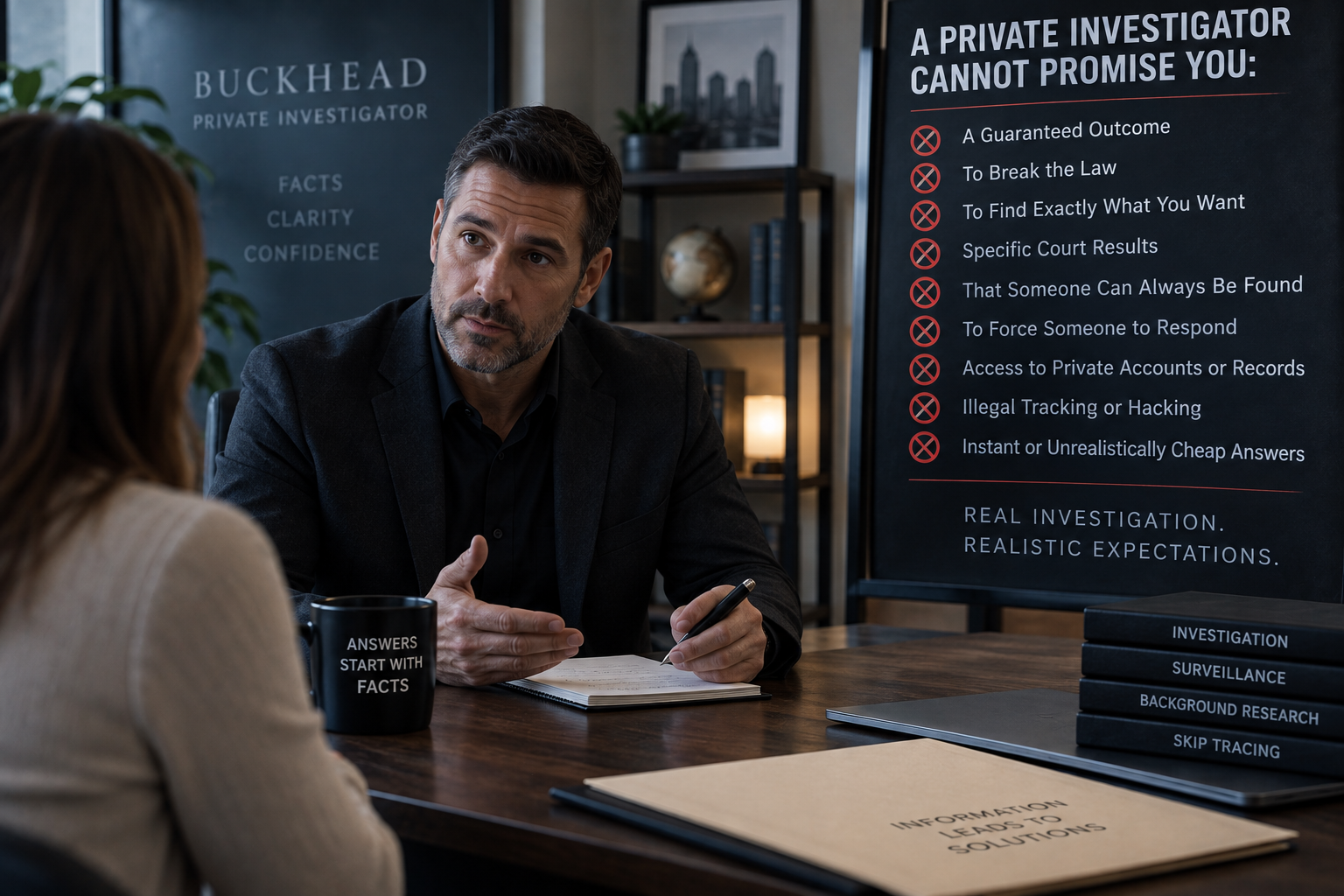
A PI cannot hack email, access private bank accounts, illegally track a vehicle, trespass, impersonate law enforcement, break into property, obtain confidential records without authorization, or harass the other party. If someone promises those things, that is a red flag.
Professional investigators work within the law because improperly gathered information can create problems for the client and may not be usable.
Buckhead Private Investigator’s article on what are the limits of private investigation in Georgia explains why realistic expectations are important.
What to Bring to a Consultation
If you are considering hiring a PI for a business dispute, gather the information you already have. Useful materials may include names, business names, addresses, phone numbers, emails, contracts, invoices, screenshots, public profiles, payment records, timelines, court documents, photos, vehicle details, and known associates.
Be honest about what you know and what you suspect. Do not exaggerate or leave out details that may affect the investigation. The clearer the starting point, the easier it is to recommend the right approach.
Also be clear about your goal. Are you trying to locate someone? Verify a claim? Document behavior? Support an attorney? Confirm business ties? Identify assets? Understand whether the dispute is worth pursuing?
A focused goal can save time, money, and confusion.
When to Contact Buckhead Private Investigator
A business dispute may call for a private investigator when important facts are missing, someone cannot be located, business ties are unclear, surveillance may be needed, a witness matters, online information is suspicious, or the other party’s story does not match available evidence.
Buckhead Private Investigator can help review the situation and determine whether background research, skip tracing, surveillance, witness location, or another investigative method may be appropriate.
To discuss a sensitive business dispute confidentially, contact Buckhead Private Investigator.
Final Thoughts
Business disputes can become expensive, emotional, and disruptive when facts are unclear. A private investigator can help bring clarity by locating people, verifying claims, documenting activity, identifying business ties, reviewing public records, and organizing findings in a factual way.
Not every dispute requires a PI. But when missing information is holding you back from making a decision, professional investigation can help you move from suspicion to facts.
The key is to act carefully. Avoid risky DIY tactics, involve an attorney when the matter may become legal, and work with an investigator who understands discretion, legal limits, and professional documentation.