Elder financial exploitation can be difficult to recognize at first. A family member may notice unusual withdrawals, new “friends” asking for money, unpaid bills, missing valuables, sudden changes in financial behavior, or a caregiver who seems too involved in an older adult’s finances. Sometimes the concern is clear. Other times, something simply feels wrong.
If you are worried that an older parent, grandparent, relative, neighbor, or vulnerable adult is being financially exploited, you may wonder whether a private investigator can help. In some situations, a private investigator may help gather information, document patterns, verify identities, review public records, locate people involved, and organize facts that can be shared with an attorney, bank, law enforcement, or Adult Protective Services.
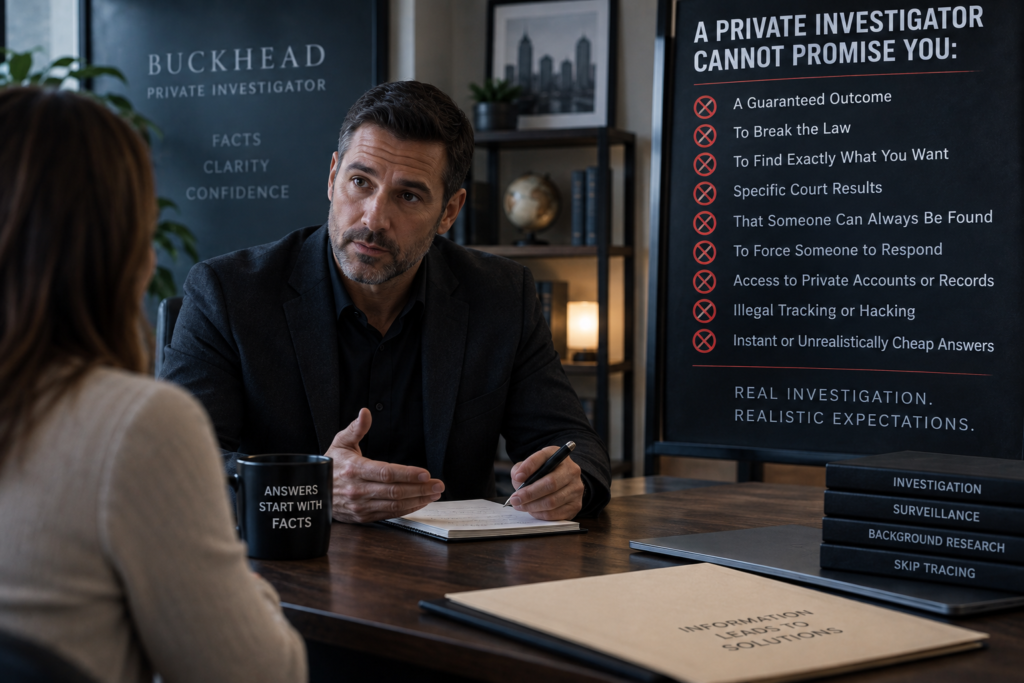
A private investigator cannot make legal findings, force someone to cooperate, recover money, access private bank records without authorization, or replace emergency services. But they may help clarify what is happening when the situation is confusing, sensitive, or difficult to document.
In Georgia, Adult Protective Services investigates reports of abuse, neglect, or exploitation involving adults 65 and older, or adults 18 and older with a disability, who do not live in long-term care facilities. Georgia APS also notes that it is not a first responder and that 911 should be called if someone is in immediate danger.
What Is Elder Financial Exploitation?
Elder financial exploitation generally involves taking, misusing, controlling, or manipulating an older adult’s money, property, benefits, accounts, documents, or financial resources for someone else’s gain. It can happen through scams, caregiver abuse, family pressure, forged signatures, suspicious transfers, misuse of power of attorney, fake charities, romance scams, contractor fraud, or pressure to change legal documents.
The Georgia Attorney General’s Office describes exploitation as taking away property or money by undue influence, force, threat, or deceit; misusing financial resources for another’s gain; taking a Social Security check without consent; forging a signature; or having someone sign power of attorney or other documents without understanding what they are signing.
The Consumer Financial Protection Bureau also warns that losing money or possessions to scams, fraud, and exploitation can be especially devastating for older adults because they may not be able to earn back what they lost.
Warning Signs Families May Notice
Financial exploitation often shows up as a pattern rather than one obvious event. Family members may notice unexplained withdrawals, new credit card charges, unpaid bills, missing checks, unusual bank activity, money transfers to unfamiliar people, sudden gifts, changes in beneficiaries, or new people taking control of financial decisions.
Other warning signs may include an older adult seeming fearful, confused, isolated, or suddenly secretive about money. A caregiver, relative, romantic partner, contractor, or new acquaintance may start answering questions for them, restricting access, or becoming defensive when finances are discussed.
Sometimes the signs are subtle. A person may say they “loaned” money but cannot explain the details. They may insist everything is fine while bills go unpaid. They may be embarrassed to admit they were deceived. They may depend on the person taking advantage of them for transportation, housing, care, or companionship.
These situations can be emotionally complicated. Documentation matters because suspicion alone may not be enough to get help.
When a Private Investigator May Help
A private investigator may help when the concern involves unclear facts, suspicious people, inconsistent stories, missing information, or the need to document patterns. For example, a PI may help identify whether a new acquaintance is using a false name, whether a caregiver has a concerning public record history, whether a person connected to the older adult has multiple aliases or business ties, or whether suspicious activity fits a larger pattern.
A PI may also help locate someone who received money and then disappeared, verify addresses, document visits, review public records, or organize a timeline of events. This can be useful before speaking with an attorney, bank, law enforcement, or protective services.
Buckhead PI’s article on What Information Can a Private Investigator Find About Someone? explains the types of lawful information an investigator may be able to research.
A PI Can Help Verify Identity
Many exploitation concerns begin with uncertainty about who someone really is. A new romantic interest, caregiver, contractor, financial helper, roommate, or “friend” may become unusually close to the older adult. They may ask for money, move into the home, gain access to accounts, or influence decisions.
A private investigator may help verify identity information, address history, public records, business connections, criminal or civil records where available, social media activity, aliases, or other lawful sources. The goal is not to make assumptions based on someone’s appearance or background. The goal is to verify whether the person’s story matches public facts.
Buckhead PI’s article on Can a Private Investigator Help Verify Someone’s Identity? would be a natural related topic if added later, but for now, Background Checks in Buckhead: What a Private Investigator Can Legally Find is a relevant internal resource.
Public Records May Reveal Useful Clues
Public records can sometimes reveal information that helps families understand risk. This may include civil lawsuits, business filings, property records, bankruptcy records, professional records, prior addresses, or connections to other entities.
For example, a person asking an older adult for investment money may have a history of lawsuits. A contractor pressuring an older homeowner may have dissolved businesses or prior disputes. A caregiver may be using a different name than the one they gave the family.
Public record research must be handled carefully. Records can be incomplete, outdated, or connected to the wrong person. A private investigator can help verify identity before drawing conclusions.
Buckhead PI’s article on What Can a Private Investigator Do That an Online Search Cannot? explains why professional verification can be more reliable than relying on one online search result.
Surveillance May Be Appropriate in Some Situations
Surveillance is not always needed in elder financial exploitation concerns, but it can be helpful in certain situations. For example, family members may be concerned that someone is repeatedly visiting the home, transporting the older adult to financial institutions, removing property, or pressuring them in person.
Lawful surveillance may document public activity, visits, vehicles, dates, times, and patterns. It should not involve trespassing, entering private spaces, recording private conversations illegally, or harassing anyone.
The goal is objective documentation. If a person is regularly visiting right before bank withdrawals, removing items from the home, or staying at the property without family knowledge, that information may be useful to an attorney or appropriate authorities.
Buckhead PI’s article on What Happens During a Surveillance Investigation? explains how surveillance should focus on lawful observation and documentation.
Documentation Can Help Banks, Attorneys, and Authorities
When families suspect exploitation, they often have scattered pieces of information: a strange bank notice, a concerning text, a new name, a suspicious withdrawal, a missing item, or a confusing story. A private investigator may help organize those pieces into a timeline.
A useful timeline may include dates, amounts, people involved, communications, addresses, public record findings, observed patterns, and supporting documentation. This can help an attorney understand the issue more quickly. It may also help a bank investigate suspicious activity or help authorities identify what needs review.
Georgia’s official state guidance says suspected elder abuse should be reported immediately to Adult Protective Services, and reports are confidential. It also notes that local law enforcement should be contacted for a welfare check and 911 should be called if someone is in immediate danger.
Buckhead PI’s article on How Private Investigators Document Evidence for Court explains why organized documentation can be more useful than vague concerns.
When Adult Protective Services Should Be Contacted
If you suspect abuse, neglect, or exploitation of an older adult or adult with a disability in Georgia, Adult Protective Services may be the appropriate agency to contact. Georgia APS investigates abuse, neglect, and exploitation reports involving older adults 65 and older or adults 18 and older with disabilities who are not in long-term care facilities.
Georgia’s reporting page also notes that abuse, neglect, or exploitation involving someone in a long-term care facility should be reported to the Georgia Department of Community Health’s Healthcare Facility Regulation division.
A private investigator should not be used as a substitute for emergency intervention or mandatory reporting. If there is immediate danger, call 911. If there is suspected exploitation, abuse, neglect, or self-neglect, consider reporting to the appropriate agency and speaking with an attorney.
Financial Institutions May Be Important Allies
Banks and credit unions may notice suspicious activity before family members do. They may see unusual withdrawals, new authorized users, sudden wire transfers, repeated gift card purchases, or changes in account behavior.
The CFPB provides resources for older adults, family members, caregivers, and financial institutions on preventing and reporting elder financial exploitation. It also encourages planning tools such as trusted contacts and financial caregiver guidance.
If you are legally authorized to help the older adult, contacting the financial institution may be an important step. If you are not authorized, the bank may have privacy limits, but it may still have internal procedures for suspicious activity reports or elder exploitation concerns.
A PI may help provide outside documentation, but financial institutions control their own account review and reporting processes.
Scams May Involve People Far Outside Georgia
Not all exploitation involves someone local. Some cases involve romance scams, fake investment opportunities, tech support scams, lottery scams, charity scams, cryptocurrency schemes, impostor scams, or online contacts who may be outside Georgia or even outside the country.
In those situations, a private investigator may help review online identities, preserve communications, identify inconsistencies, research names or entities, and determine whether the contact appears legitimate. However, recovering money from scams can be difficult, especially if funds were wired, converted to cryptocurrency, or sent overseas.
The CFPB’s Money Smart for Older Adults program, developed with the FDIC, provides resources to help older adults, family caregivers, and others prevent, recognize, and report fraud and exploitation.
Buckhead PI’s article on Can a Private Investigator Help If You Think You Are Being Scammed? would be a strong related topic if added later, but the existing article on How Private Investigators Help With Online Dating Safety Concerns is relevant for romance-scam concerns.
What a Private Investigator Cannot Do
A private investigator cannot access private bank records without legal authorization. They cannot hack accounts, monitor private communications illegally, force a caregiver to cooperate, remove someone from a home, recover stolen funds, freeze accounts, or decide whether a crime occurred.
They also cannot give legal advice about guardianship, conservatorship, power of attorney, wills, trusts, or financial liability. Those questions should be discussed with an attorney.
A PI can gather lawful information, document observations, verify identities, locate people, and organize facts. But legal action, protective intervention, banking decisions, and criminal investigations belong to the appropriate professionals and agencies.
Buckhead PI’s article on What a Private Investigator Cannot Promise You is a useful related resource for understanding realistic expectations.
Why Attorney Guidance May Be Needed
Elder financial exploitation concerns often overlap with legal issues. A family may need advice about power of attorney, guardianship, estate documents, bank access, civil claims, protective orders, or law enforcement reports.
An attorney can explain what legal authority you have, what steps are available, and how to preserve evidence properly. A private investigator may support the attorney’s work by gathering facts and documentation.
This is especially important if the suspected exploiter is a family member, caregiver, romantic partner, agent under power of attorney, trustee, contractor, or business associate. The legal options may differ depending on the relationship and documents involved.
Buckhead PI’s article on What Is Considered Legal Evidence in a Private Investigation? explains why lawfully gathered evidence matters if the concern becomes a legal case.
What to Share With a PI Before Starting
If you contact a private investigator about elder financial exploitation concerns, gather what you can first. Helpful information may include:
The older adult’s name and general situation
The suspected person’s name or description
Known addresses and phone numbers
Relationship between the parties
Dates of concerning events
Bank notices or transaction concerns you are allowed to share
Screenshots of messages or public posts
Names of caregivers, contractors, or new acquaintances
Recent changes in behavior or access
Missing property details
Any attorney or APS involvement
Any safety concerns
Be clear about what you know, what you suspect, and what you are legally allowed to access. Do not obtain records improperly. If you are unsure, ask an attorney before sharing sensitive financial documents.
When Hiring a PI May Make Sense
Hiring a private investigator may make sense if there are unclear identities, suspicious visitors, concerning new relationships, missing property, inconsistent stories, public record questions, address verification needs, or a need to organize facts before meeting with an attorney.
A PI may also help when family members live out of state and need lawful documentation of who is visiting, where someone may be located, or whether a suspicious person has a concerning background.
However, if the older adult is in immediate danger, being threatened, neglected, physically harmed, or unable to access basic needs, call emergency services or the appropriate protective agency first.
Final Thoughts
A private investigator may be able to help with elder financial exploitation concerns by verifying identities, researching public records, documenting patterns, locating people, and organizing facts for attorneys, banks, law enforcement, or protective agencies.
But a PI cannot replace Adult Protective Services, emergency responders, law enforcement, financial institutions, or legal counsel. If someone is in immediate danger, call 911. If you suspect abuse, neglect, or exploitation of an older adult or adult with a disability in Georgia, consider reporting it to Adult Protective Services or the appropriate state agency.
Elder financial exploitation is serious, and early documentation can matter. If you are concerned about suspicious financial activity involving an older adult in Buckhead or the Atlanta area, contact Buckhead Private Investigator to discuss discreet, lawful investigative support.