Hiring a contractor, vendor, subcontractor, consultant, or service provider can involve more risk than people realize. A company may have a polished website, confident sales pitch, professional-looking proposal, or strong referral, but that does not always mean the business is reliable, properly represented, or free from concerning history.
For homeowners, a bad contractor can lead to unfinished work, financial loss, property damage, liens, delays, or disputes. For business owners, the wrong vendor can create operational problems, reputational risk, contract issues, data concerns, or financial exposure.
That is why due diligence matters before signing an agreement, sending a deposit, sharing sensitive information, or relying on a vendor for important work.
A private investigator may be able to help with contractor or vendor due diligence by verifying identity, business registration, litigation history, ownership connections, address information, reputation concerns, public records, and inconsistencies in the information provided. A PI cannot guarantee that a contractor will perform well, but they may help uncover facts that support a more informed decision.
Why Contractor and Vendor Due Diligence Matters
Due diligence is the process of checking information before entering a business relationship. It is not about assuming every contractor or vendor is dishonest. It is about confirming that the person or company is who they say they are and that there are no obvious warning signs before money or trust changes hands.
A contractor may claim years of experience, a valid business entity, proper insurance, strong references, or a clean track record. A vendor may claim certain ownership, credentials, capabilities, partnerships, financial stability, or service history. Some claims may be easy to verify. Others may require deeper research.
The Federal Trade Commission recommends checking references, comparing bids, reading contracts carefully, and researching a company’s name with terms like “scam,” “review,” or “complaint” before hiring a home improvement contractor. The FTC also warns consumers to be cautious of contractors who pressure them, ask for large upfront payments, or want payment in cash.
A private investigator can help when basic online research is not enough or when the project, contract, or risk level justifies a deeper look.
What a Private Investigator May Verify
A private investigator may help verify several types of information, depending on the assignment and legal limits. This may include the business name, owner names, registered agent, business address, active or inactive entity status, public records, litigation history, professional claims, aliases, related companies, address history, and public reputation concerns.
In Georgia, the Secretary of State’s Corporations Division provides a business search tool for business entities, service of process, and trademarks filed with the office. That type of public record can be a useful starting point, but it may not tell the full story. A company can be registered and still have poor performance, unresolved disputes, hidden ownership concerns, or unrelated licensing issues.
A PI may also compare what the vendor told you against public records. Are they using the same business name? Is the company active? Does the address match? Are there multiple similarly named entities? Does the registered agent information make sense? Are there dissolved companies connected to the same people?
These details can help identify inconsistencies before you sign a contract.
Business Registration Is Only One Piece of the Puzzle
Finding a company in a state database can be reassuring, but it should not be treated as a complete background check. Business registration usually confirms that an entity exists or existed in a filing system. It does not necessarily prove that the business is licensed for a specific trade, insured, financially stable, dispute-free, or qualified for the work.
For example, a contractor may have an LLC registered with the state, but the trade work may require separate licensing, permits, or insurance depending on the job. A vendor may have a registered business but still have a history of lawsuits, complaints, unpaid debts, or changing company names.
This is why due diligence should look at multiple sources rather than one search result. Buckhead PI’s article on what can a private investigator do that an online search cannot explains why professional verification can be helpful when public information is scattered, outdated, or incomplete.
A PI Can Look for Ownership and Alias Connections
One reason contractor or vendor due diligence can get complicated is that people may operate under multiple names. A contractor may use a trade name, personal name, LLC name, former company name, or related business. A vendor may have several entities connected to the same owner.
Not all name changes are suspicious. Businesses rebrand, merge, change services, move locations, or form new entities for legitimate reasons. But repeated name changes, dissolved entities, similar businesses with different owners, or unclear ownership can be worth reviewing.
A private investigator may help identify whether the person you are dealing with is connected to other businesses, prior disputes, public records, or aliases. This can be especially useful if something feels inconsistent, such as a contractor who gives one business name on the estimate, another on the invoice, and a third on online listings.
Buckhead PI’s article on how to know if someone is misrepresenting their business background would be a natural related topic if added later, but for now, the existing article on can a private investigator help confirm someone’s employment or business ties is closely connected.
Litigation and Court Record Searches May Matter
For larger contracts, court records can be an important part of due diligence. A prior lawsuit does not automatically mean someone is dishonest or unqualified. Businesses can be involved in disputes for many reasons. However, repeated lawsuits, unresolved judgments, fraud allegations, contract disputes, or patterns of nonpayment may be relevant before entering a new relationship.
A private investigator may help search public court records and organize findings in a way that is easier to review. They may look for civil cases, business disputes, collections, liens, bankruptcy-related information, or other public records depending on the scope.
The key is interpretation. A PI can gather and summarize public information, but an attorney should help interpret legal significance. If the contract is large or the risk is high, due diligence findings may be something to discuss with legal counsel before moving forward.
Buckhead PI’s article on when a business dispute calls for a private investigator explains how documentation and fact-finding can matter when business relationships become contested.
Due Diligence Can Help With Contractor Scams
Contractor scams often involve pressure, urgency, vague contracts, unusual payment demands, unclear business identity, or promises that sound too good to be true. The FTC advises consumers to get written estimates, check references, understand contracts, avoid paying the full amount upfront, and be careful with high-pressure sales tactics.
A private investigator may help when you are unsure whether the person or business is legitimate. For example, they may verify whether the contractor’s address is real, whether the business name is active, whether the person has a pattern of complaints, whether online information matches public records, or whether the company has recently changed names.
This can be especially valuable after storms, emergencies, or urgent repairs, when dishonest contractors may pressure homeowners to act quickly. Even in high-stress situations, basic verification can help prevent bigger problems.
Vendor Due Diligence Is Not Only for Home Projects
Vendor due diligence also matters for businesses. A company may rely on vendors for marketing, IT, security, logistics, consulting, construction, facilities, bookkeeping, staffing, or specialized services. A questionable vendor can create financial, operational, legal, or reputational problems.
A PI may help verify whether a vendor’s ownership, business history, public claims, or related entities are accurate. This can be useful before signing a long-term contract, sharing confidential information, issuing a large deposit, or entering a partnership-like relationship.
Buckhead PI’s article on when a business dispute calls for a private investigator is especially relevant for business owners who are trying to avoid disputes before they start.
Red Flags Worth Investigating Further
Not every concern requires hiring a private investigator, but certain red flags may justify deeper due diligence. These may include:
A business name that does not match the contract
No clear physical address
Pressure to pay quickly
Large cash deposit requests
Refusal to provide references
Inconsistent owner or company information
Multiple recently dissolved businesses
Poor or suspicious online reviews
Threatening or evasive communication
Unclear insurance or licensing information
Lawsuits involving similar complaints
A proposal that is much lower than others
A vendor who refuses written terms
Claims that cannot be verified
One red flag does not always mean fraud. But several red flags together should slow the process down.
What a PI Cannot Guarantee
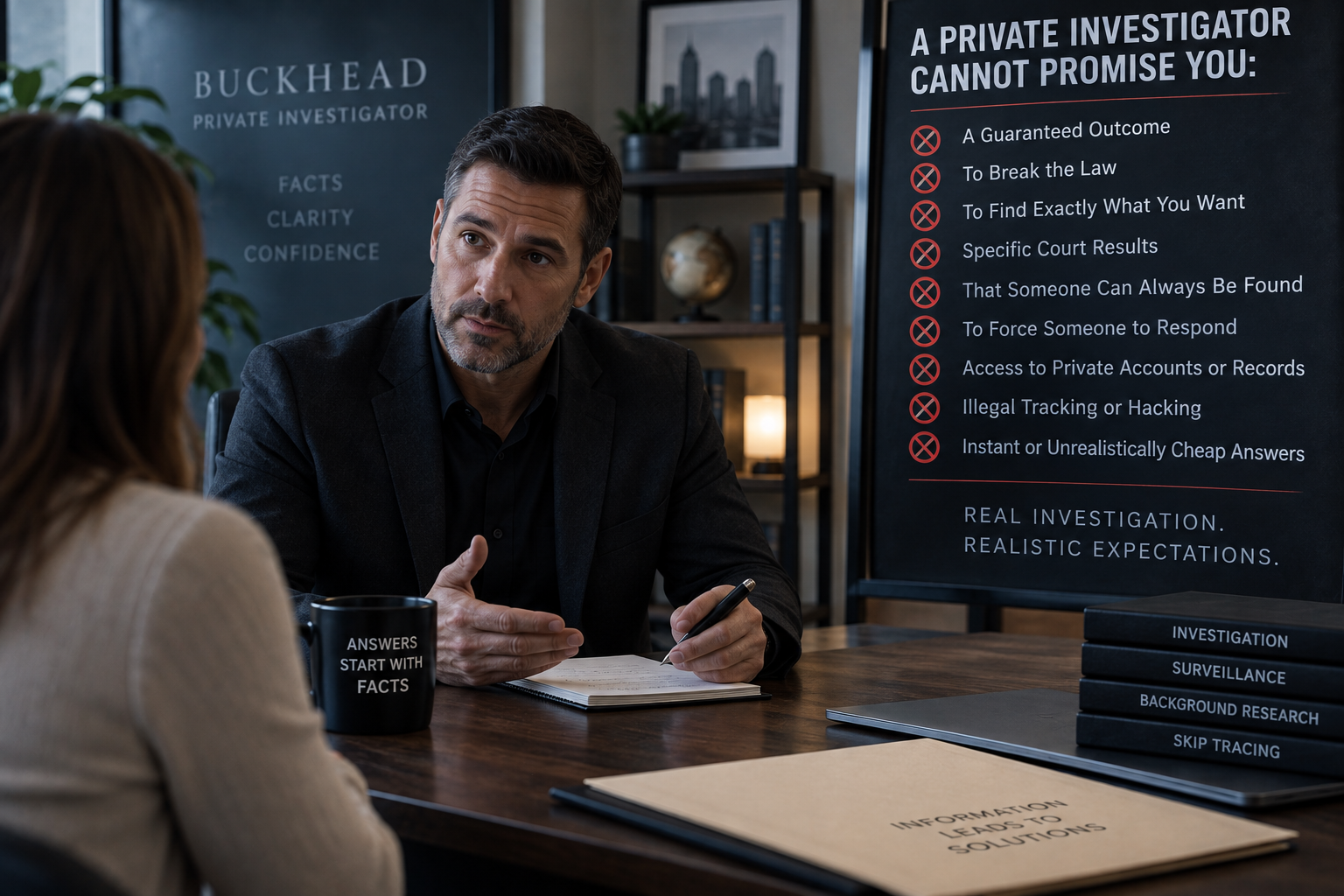
A private investigator cannot guarantee that a contractor will finish the job, that a vendor will perform well, or that no future dispute will happen. They also cannot access protected records illegally, hack private accounts, obtain confidential financial information without authorization, or make legal conclusions.
A PI’s role is to gather lawful information, verify claims, document public facts, and identify inconsistencies. That information can help you ask better questions, involve an attorney if needed, or decide whether to proceed.
Buckhead PI’s article on what a private investigator cannot promise you explains why realistic expectations matter before starting any investigation.
Why Licensing and Professional Standards Matter
If you hire a private investigator for due diligence, make sure the investigator is properly licensed. In Georgia, private detective businesses are regulated by the Georgia Board of Private Detective and Security Agencies, which administers the state’s Private Detective & Security Agencies Act to safeguard citizens through regulation of private detective and security businesses.
Georgia rules also state that advertising material distributed or published by a private detective agency or security agency must display the agency license number issued by the Board.
This matters because due diligence work should be handled carefully. A licensed investigator should understand legal boundaries, privacy concerns, documentation standards, and ethical fact-gathering.
When Attorney Review May Be Needed
If due diligence uncovers lawsuits, unpaid judgments, contract disputes, suspicious business structures, licensing concerns, or unclear ownership, it may be time to speak with an attorney before signing anything.
An attorney can review the contract, explain your risk, suggest protective clauses, recommend documentation, or advise you not to proceed. A private investigator can gather facts, but legal interpretation belongs to a lawyer.
This is especially important for large deposits, commercial contracts, construction agreements, business partnerships, franchise-type arrangements, or vendors who will handle sensitive information.
Buckhead PI’s article on what is considered legal evidence in a private investigation explains why properly gathered information is important if the issue later becomes a legal dispute.
What to Share Before Starting a Due Diligence Investigation
Before contacting a private investigator, gather the information you already have. Useful details may include:
The contractor or vendor’s full name
Business name and trade names
Website and social media profiles
Phone numbers and email addresses
Physical address or mailing address
Written estimate or proposal
Contract draft
Insurance or license information provided
Names of owners or sales representatives
Payment requests
References provided
Screenshots of concerning claims
Any prior communication
The more organized the starting information is, the more focused the investigation can be. A PI can then compare the provided details against public records, online information, and other lawful sources.
When Hiring a PI Makes Sense
Hiring a PI for contractor or vendor due diligence may make sense when the project is expensive, the vendor will have access to your home or business, the company information feels inconsistent, the contractor is requesting a large deposit, public records are confusing, or the relationship could create significant risk.
It may also make sense when you are already seeing warning signs but do not have enough information to decide whether to walk away.
A PI may be especially helpful before major home renovations, commercial build-outs, vendor contracts, business partnerships, high-value purchases, or situations where the person’s identity or business history is unclear.
Final Thoughts
A private investigator may help with contractor or vendor due diligence by verifying business identity, ownership ties, address information, public records, litigation history, reputation concerns, and inconsistencies before you make a financial commitment.
Due diligence does not guarantee a perfect outcome, but it can help reduce risk. It gives you a clearer picture before signing a contract, paying a deposit, granting access, or relying on a vendor for important work.
If you are considering a contractor, vendor, or business relationship and something does not feel right, slow down before moving forward. For discreet, lawful due diligence support in Buckhead and the Atlanta area, contact Buckhead Private Investigator.