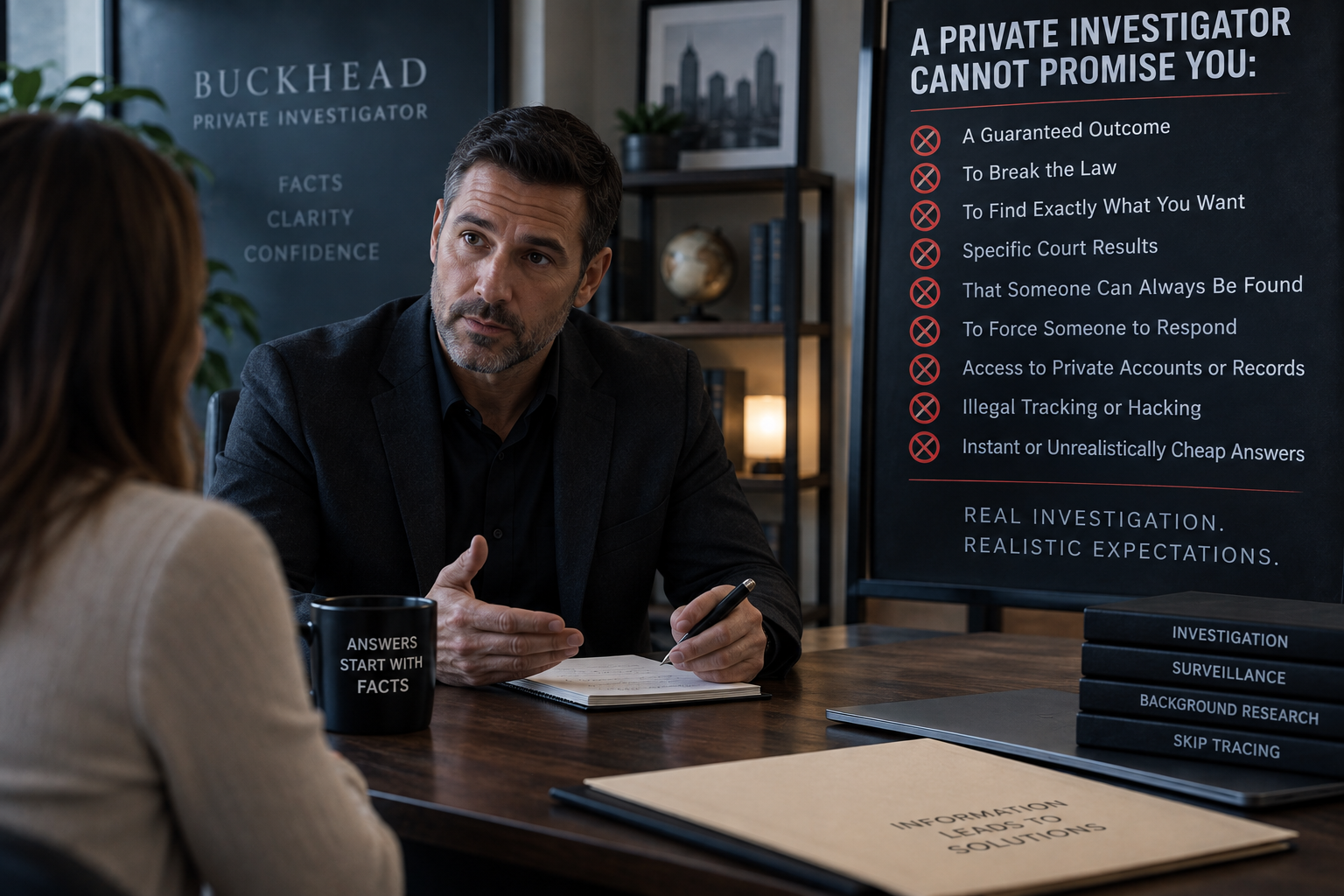
One of the first questions people ask before hiring a private investigator is, “How long will this take?” It is a fair question. If you are dealing with suspected infidelity, a child custody concern, a missing person, fraud, employee misconduct, or a sensitive legal matter, you probably want answers quickly.
The honest answer is that a private investigation can take anywhere from a few hours to several weeks or longer, depending on the type of case, the complexity of the situation, the subject’s behavior, the amount of information available, and the kind of proof needed.
Some investigations are simple. A private investigator may be able to verify an address, confirm employment activity, or conduct a short surveillance assignment in a day or two. Other cases require multiple surveillance sessions, public records research, interviews, background checks, documentation, and coordination with attorneys. Those cases naturally take longer.
For clients in Buckhead, the most important thing to understand is that a good investigation is not just about speed. It is about gathering accurate, lawful, useful information. Rushing the process can lead to missed details, weak evidence, or unnecessary risk. A licensed private investigator should explain what is realistic based on the facts of your case.
The Type of Investigation Affects the Timeline
Different private investigation services take different amounts of time. A background check is usually faster than a multi-day surveillance case. A skip trace may be quicker than a complex fraud investigation. An infidelity investigation may take one night or several weeks, depending on the subject’s schedule.
Common investigation timelines may look like this:
A basic background check may take a few days.
A short surveillance assignment may take one evening, one day, or several days.
An infidelity investigation may take a few days to a few weeks.
A child custody investigation may take several days or longer, depending on the concerns.
A missing person or skip tracing case may take a few days to several weeks.
A business fraud or employee misconduct case may take longer if records, surveillance, interviews, and documentation are involved.
These are general ranges, not guarantees. Every case depends on the information available and the type of proof the client needs.
Surveillance Cases Depend on the Subject’s Behavior
Surveillance is one of the most time-sensitive types of private investigation. Many clients assume a private investigator can follow someone for a few hours and immediately get answers. Sometimes that happens, but not always.
If the subject follows a predictable schedule, surveillance may produce results quickly. For example, if someone claims to work late every Thursday but consistently visits another location instead, an investigator may be able to document that pattern in one or two surveillance sessions.
If the subject’s schedule is unpredictable, the investigation may take longer. They may change plans, stay home, drive to multiple locations, or not do anything relevant during the first surveillance period.
Private investigators are not controlling the subject’s behavior. They are documenting what actually happens. That means the timeline often depends on when the subject creates observable activity.
Infidelity Investigations Can Vary Widely
Infidelity cases are one of the most common reasons people hire private investigators. They can also vary greatly in length.
Some clients already have useful information. They may know the likely day, time, location, vehicle, or person involved. In those cases, a private investigator can plan surveillance more efficiently. If the spouse or partner has a predictable pattern, the investigation may produce results quickly.
Other clients only have a general suspicion. They may notice secrecy, emotional distance, unexplained absences, or unusual phone behavior, but they do not know when or where anything may be happening. In those cases, the investigator may need more time to identify patterns.
An infidelity investigation might take one evening if the activity happens during surveillance. It may take several days if the subject is inconsistent. It may take longer if the client needs stronger documentation, such as repeated meetings, overnight stays, or a clear timeline of behavior.
The goal is not just to “catch” someone. The goal is to gather factual, lawful documentation that helps the client understand what is going on.
Child Custody Investigations May Require More Documentation
Child custody investigations often take longer than simple surveillance because the stakes are higher and the evidence may need to be more carefully documented.
A parent may be concerned about custody agreement violations, unsafe environments, substance use, unauthorized caregivers, neglect, or dishonest claims about parenting time. One observation may not be enough to show a meaningful pattern. The investigator may need to document multiple dates, locations, drop-offs, pickups, overnight stays, or repeated behavior.
These investigations must also be handled carefully to avoid interfering with the child, violating court orders, or escalating the situation. A private investigator should not frighten, approach, or involve the child unnecessarily.
Because custody concerns may connect to legal proceedings, clients should often work with both a private investigator and a family law attorney. The investigator gathers facts; the attorney explains how those facts may matter legally.
Background Checks and Public Records Research May Be Faster
Some investigations do not require physical surveillance. Background checks, public records searches, address verification, employment-related research, and due diligence investigations may be completed faster than cases involving field work.
A private investigator may search court records, property records, business filings, address histories, social media, professional licenses, and other lawful sources. The timeline depends on how common the subject’s name is, how much identifying information is available, how many jurisdictions need to be checked, and how deep the research needs to go.
A simple background check may take a few days. A deeper due diligence investigation may take longer if it involves multiple states, business connections, litigation history, financial concerns, aliases, or difficult-to-verify information.
Clients can help speed this up by providing accurate identifying details, such as full legal name, date of birth, known addresses, phone numbers, email addresses, employer information, vehicle information, or known associates.
Missing Person and Skip Tracing Cases Depend on Available Information
A private investigator may help locate someone’s current address, find a witness, reconnect with a family member, identify an heir, or locate someone who is avoiding contact. These cases are often called skip tracing or locate investigations.
The timeline depends heavily on the information available. If the client has a full name, date of birth, previous addresses, phone numbers, relatives, employment history, or vehicle details, the investigator may be able to move faster. If the person has intentionally disappeared, uses aliases, moves frequently, avoids digital records, or has limited public information, the case may take longer.
Some locate investigations are resolved in a few days. Others may require extended research, database searches, public records review, social media research, and field verification.
A private investigator should be honest if a locate case is likely to be difficult. No ethical investigator can guarantee that every person will be found.
Business Investigations May Take Longer
Business-related investigations can be more complex because they may involve records, surveillance, interviews, employee behavior, vendor relationships, fraud concerns, theft, workers’ compensation issues, or misuse of company resources.
For example, an employer may suspect that an employee is working another job while claiming an injury. A business owner may suspect internal theft. A company may need help documenting fraud, false claims, or unauthorized activity.
These cases may require planning, multiple surveillance periods, review of records, coordination with company leadership, and careful documentation. If attorneys are involved, the process may also include strategy discussions about what evidence is needed and how it should be gathered.
A business investigation might take several days, several weeks, or longer depending on the scope.
The Quality of Information You Provide Matters
Clients can often shorten the investigation timeline by providing accurate, useful information upfront. The more the investigator knows, the better they can plan.
Helpful information may include:
Full name of the subject
Recent photo
Vehicle make, model, color, and license plate
Known addresses
Work schedule
Typical routines
Known associates
Social media profiles
Relevant dates and times
Reason for the investigation
Any court orders or legal restrictions
Specific questions the client wants answered
Poor or incomplete information can slow the process. For example, if a client only knows a nickname and a general area, the investigator may need to spend more time identifying the right person before surveillance or research can begin.
A consultation helps organize these details so the investigation starts with a clear plan.
Legal and Ethical Boundaries Can Affect the Timeline
A private investigator must follow the law. In Georgia, private detective businesses are regulated, and state law sets licensing requirements for private detective and private security businesses. A legitimate investigator cannot trespass, hack phones, break into accounts, secretly record private conversations, impersonate law enforcement, or harass someone to get faster results.
Georgia law also addresses stalking, including following, placing under surveillance, or contacting another person without consent for the purpose of harassing and intimidating them. That matters because surveillance must be conducted for a legitimate purpose and within lawful boundaries.
Sometimes, doing the investigation legally takes longer than taking shortcuts. That is a good thing. Evidence gathered through illegal methods can create serious problems and may be unusable. A professional investigator will prioritize lawful methods, even if that means the case takes more time.
Some Cases Need Multiple Attempts
Not every investigation produces useful information on the first attempt. A subject may stay home. They may cancel plans. They may leave before surveillance begins. They may change vehicles. They may visit a location with poor visibility. They may not do anything relevant during the scheduled window.
That does not mean the investigation failed. It may simply mean more time is needed.
Professional investigators often adjust strategy based on what they learn. If the first surveillance period shows no activity, they may recommend a different day, time, or location. If the subject appears to follow a pattern, they may narrow the next attempt. If the case is not producing results, they may advise the client to pause, gather more information, or change direction.
A good investigation is flexible.
What Happens After the Investigation?
The timeline does not end when field work stops. The private investigator still needs to organize notes, review photos or video, prepare a report, create a timeline, and explain findings to the client.
A final report may include dates, times, locations, observations, photographs, video references, vehicle descriptions, and a summary of relevant activity. In legal matters, the client may share the report with an attorney.
The reporting phase may take additional time depending on the amount of evidence collected. A one-day surveillance report may be completed quickly. A multi-week investigation with several locations, subjects, and media files will take longer to organize.
How to Set Realistic Expectations
Before hiring a private investigator, ask what timeline is realistic for your case. A reputable investigator should not promise instant answers or guaranteed results. Instead, they should explain the likely process, what information will help, what challenges may affect timing, and how updates will be provided.
Good questions to ask include:
How many hours do you recommend starting with?
What days or times are most strategic?
What information do you need from me?
How will you document findings?
What happens if the first attempt does not produce results?
When will I receive the report?
Clear expectations help reduce frustration and keep the investigation focused.
Final Thoughts
A private investigation can take a few hours, a few days, several weeks, or longer depending on the type of case and the evidence needed. Surveillance, infidelity, child custody, missing person, background check, and business investigations all have different timelines.
The best way to estimate the length of an investigation is to speak with a licensed private investigator about the specific facts. The more accurate information you can provide, the easier it is to create a focused plan.
If you need answers in Buckhead, a professional private investigator can help you understand what timeline is realistic, what methods are legal, and what kind of documentation may be possible. A careful investigation may take time, but reliable facts are worth more than rushed assumptions.