Divorce can become more complicated when one spouse believes the other is living with a new partner while still presenting themselves differently in court or during negotiations. Cohabitation concerns may come up during alimony discussions, post-divorce modifications, custody disputes, financial disagreements, or broader questions about honesty and lifestyle.
If you suspect someone is cohabiting during or after a divorce, you may wonder whether a private investigator can help prove it. The answer is that a private investigator may be able to help document patterns that support or clarify a cohabitation concern, but they cannot guarantee a legal outcome or decide what counts as proof in court.
In Georgia, cohabitation may be relevant in certain alimony modification situations. Georgia law provides that, after a final divorce judgment awarding periodic alimony, voluntary cohabitation of the former spouse with a third party in a meretricious relationship can be grounds to modify periodic permanent alimony. The statute also defines cohabitation as dwelling together continuously and openly in that type of relationship.
Because these issues are legal and fact-specific, a private investigator’s role is not to interpret the divorce order or give legal advice. Their role is to gather lawful, objective information that an attorney can review and decide how to use.
Why Cohabitation Concerns Come Up in Divorce
Cohabitation concerns often come up when one spouse believes the other person’s living situation, expenses, or relationship status may affect financial support, custody concerns, or the credibility of claims being made during divorce.
For example, a person may say they live alone while spending most nights at another person’s home. They may claim certain expenses while sharing household costs with a new partner. They may deny a relationship that appears to involve shared routines, shared property use, or regular overnight stays.
These concerns can be emotional, but in a legal context, suspicion alone is usually not enough. Courts and attorneys generally need facts, timelines, documents, observations, and legally obtained evidence. That is where a private investigator may be helpful.
A related Buckhead PI article, What Should You Do If You Think Your Spouse Is Lying During Divorce?, explains why divorce concerns should be documented carefully rather than handled through confrontation or guesswork.
What a Private Investigator May Look For
A private investigator may help document whether someone appears to be spending consistent time at another residence, keeping regular overnight patterns, using a property like a primary residence, or sharing visible routines with another person.
This does not mean spying through windows, trespassing, hacking accounts, placing illegal trackers, or recording private conversations. A licensed investigator should work within legal and ethical boundaries.
Common areas of lawful investigation may include public surveillance, address research, vehicle observations from lawful locations, public record review, social media research, and documentation of visible routines. The goal is to establish patterns, not force a conclusion.
For example, an investigator may document that a person’s vehicle is repeatedly parked overnight at the same residence, that the person leaves for work from that address on multiple mornings, or that they appear to use that residence regularly over time. Whether those facts matter legally depends on the circumstances and the attorney’s strategy.
Cohabitation Is About Patterns, Not One Night
One of the most important things to understand is that cohabitation is usually not about one isolated event. Seeing someone at another person’s home once does not necessarily prove they live there. Even multiple visits may not be enough without a broader pattern.
A cohabitation investigation may focus on repeated behavior over time. Does the person stay overnight regularly? Do they appear to leave for work from the same residence? Are they bringing personal belongings back and forth? Do they receive mail there? Do they share vehicles, errands, routines, or household activities?
Georgia’s statutory language refers to dwelling together continuously and openly, which is why patterns and consistency matter.
An investigator can help gather observations, but an attorney determines whether the evidence supports a legal argument.
Surveillance May Be Part of the Investigation
Surveillance is one tool that may be used in cohabitation cases. It can help document movements, arrivals, departures, overnight stays, and routines that are visible from public or legally accessible locations.
For example, surveillance may be scheduled during evenings, early mornings, weekends, or other times when the suspected pattern is most likely to be observed. The investigator may document dates, times, photos, video, vehicle presence, and visible activity.
The value of surveillance depends on planning. Random observation may not show much. A focused strategy based on known work schedules, custody exchanges, travel patterns, or prior information may be more useful.
Buckhead PI’s article on What Happens During a Surveillance Investigation? explains how surveillance typically focuses on lawful observation and documentation, not assumptions.
Background Research Can Support the Bigger Picture
Surveillance is not the only option. Background research may help identify addresses, property ties, business connections, shared records, public filings, or other details that help clarify someone’s living situation.
For example, an investigator may look into whether the person is associated with a different address than the one they claim, whether public records connect them to a new household, or whether online information supports or conflicts with their stated living arrangement.
This type of research must be handled carefully. Online databases can be outdated, incomplete, or wrong. A professional investigator can help verify information instead of relying on a single people-search result.
Buckhead PI’s article on What Can a Private Investigator Do That an Online Search Cannot? explains why verification matters when online information is incomplete or misleading.
Social Media May Provide Clues
Social media can sometimes provide clues about cohabitation, but it should be handled carefully. Posts, tags, photos, check-ins, stories, public comments, and relationship content may help establish a timeline or pattern.
However, social media rarely tells the full story by itself. A photo at someone’s home does not necessarily prove cohabitation. A tagged location may be inaccurate. A post may be old. A person may intentionally mislead others online.
A private investigator can review public information, preserve relevant content, and look for consistency across multiple sources. They should not hack accounts, impersonate people, use fake access, or violate privacy laws.
Buckhead PI’s article on Can a Private Investigator Find Hidden Social Media Accounts? is relevant when online identity or undisclosed accounts may be part of a larger concern.
Documentation Matters More Than Suspicion
If you suspect cohabitation, it is easy to focus on what you “know” based on intuition. But legal disputes usually require documentation.
Useful documentation may include dates, times, addresses, vehicle descriptions, screenshots of public posts, known schedules, custody exchange information, financial claims, and any inconsistencies you have already noticed.
A private investigator can take that starting information and build a more organized investigation plan. The final report may include timelines, observations, photos, video, public record findings, and notes that can be shared with your attorney.
Buckhead PI’s article on How Private Investigators Document Evidence for Court explains why organized, objective reporting is often more useful than emotional claims.
What a Private Investigator Cannot Do
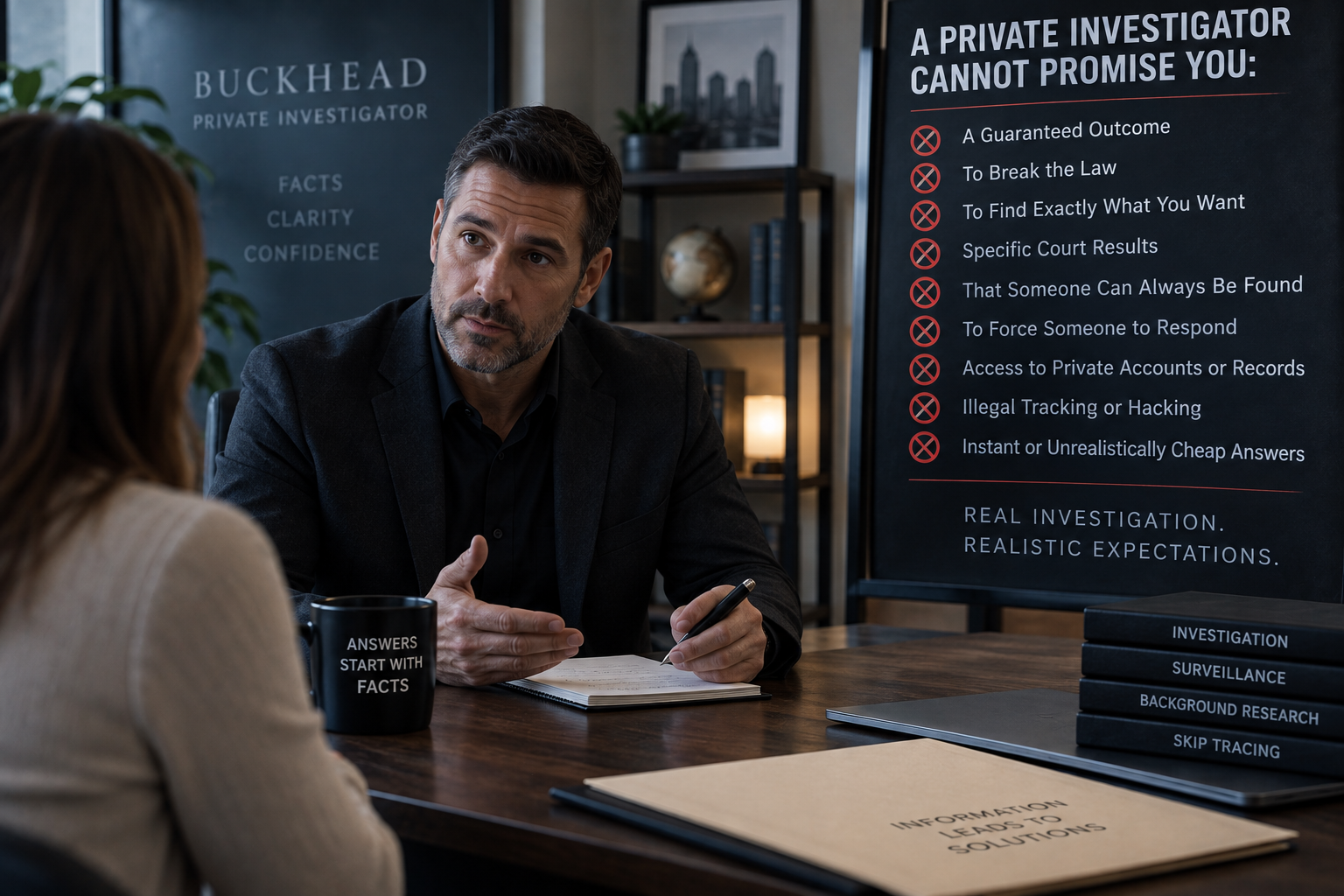
A private investigator cannot promise that cohabitation will be proven. They cannot guarantee that evidence will change alimony, custody, or divorce terms. They cannot trespass, enter private property, hack accounts, place illegal tracking devices, access protected records without authorization, or make legal decisions.
They also cannot decide whether a judge will find the evidence persuasive. That decision belongs to the court, and the legal strategy belongs to the attorney.
This matters because cohabitation concerns can be sensitive. A responsible investigator should explain what can be investigated lawfully and what cannot.
Buckhead PI’s article on What a Private Investigator Cannot Promise You is a good related resource for understanding realistic expectations before starting a case.
Why Attorney Coordination Is Important
If cohabitation is connected to alimony, divorce strategy, custody, or a court case, it is often best to involve your attorney early. Your attorney can explain what facts matter, what evidence may be useful, and what should be avoided.
An attorney may also help decide whether an investigation is worth pursuing. In some situations, the suspected cohabitation may not affect the legal issue at hand. In others, documentation may be important.
A private investigator and attorney can work together so the investigation stays focused. Instead of collecting random information, the investigator can gather facts tied to the legal question.
Buckhead PI’s article on What Is Considered Legal Evidence in a Private Investigation? explains why the way information is gathered can matter as much as the information itself.
How Long a Cohabitation Investigation May Take
The timeline depends on the situation. If the suspected pattern is frequent and predictable, an investigator may be able to document useful information more quickly. If the person’s schedule is inconsistent, if the address is uncertain, or if activity happens only occasionally, it may take longer.
Because cohabitation is often about repeated behavior, one short surveillance period may not be enough. The investigation may need to cover multiple days, weekends, or key timeframes.
Buckhead PI’s article on How Long Does a Private Investigation Usually Take? explains why timelines vary depending on the facts, goals, and type of case.
What You Should Share Before the Investigation Starts
Before hiring a private investigator, gather the information you already have. This may include:
Known addresses
Vehicle descriptions
Work schedule
Custody exchange schedule
Photos or identifying details
Public social media profiles
Relevant dates and times
Known routines
Prior statements or inconsistencies
Attorney instructions
Court orders or restrictions
You should also be honest about how you obtained the information. If something was accessed improperly, tell your attorney before sharing it with an investigator. Evidence gathered illegally or unethically can create problems.
The more accurate the starting information is, the more focused the investigation can be.
When a Cohabitation Investigation May Make Sense
A cohabitation investigation may make sense if there is a specific legal or financial issue connected to the living arrangement, if the suspected pattern is ongoing, and if your attorney believes documentation may be helpful.
It may also make sense if you need to verify facts before making a legal decision. For example, you may not want to file a motion or make an accusation without knowing whether there is evidence to support the concern.
However, it may not be worth investigating if the concern is based only on jealousy, curiosity, or a desire to monitor someone without a clear legal purpose. A private investigator should help gather relevant facts, not fuel unnecessary conflict.
Final Thoughts
A private investigator may be able to help document whether someone appears to be cohabiting during or after a divorce by gathering lawful observations, public information, timelines, address research, and supporting evidence. This can be especially relevant when cohabitation may affect alimony, financial claims, or broader divorce concerns.
But a private investigator does not decide what cohabitation means legally, cannot guarantee a court outcome, and cannot use illegal methods to gather information. The strongest approach is usually attorney-guided, fact-based, and focused on patterns rather than assumptions.
If you suspect cohabitation is affecting your divorce or post-divorce situation, speak with your attorney and consider whether professional investigation may help clarify the facts. For discreet, lawful support, contact Buckhead Private Investigator.