Evidence can make a major difference in a legal matter, but not all information is equally useful in court. A blurry photo with no context, a vague statement from an unnamed source, or an unverified online screenshot may raise more questions than it answers. For evidence to help a case, it needs to be gathered lawfully, documented clearly, preserved properly, and connected to the facts at issue.
That is where a private investigator can play an important role.
A private investigator may help attorneys, individuals, businesses, and families collect and organize information that supports a legal matter. This can include surveillance documentation, photographs, videos, witness information, background research, public records, timelines, location verification, and written reports. The goal is not simply to “find dirt” on someone. The goal is to create a factual record that may help an attorney evaluate strategy, support claims, challenge false statements, or present information through the proper legal process.
For clients in Buckhead, understanding how private investigators document evidence for court can help set realistic expectations. A licensed investigator cannot guarantee that evidence will be admitted by a judge, but they can gather information in a way that is professional, organized, and legally cautious.
If you are still learning what investigators can and cannot do, start with What Does a Private Investigator in Buckhead Actually Do?.
Evidence Must Be Gathered Legally
The first rule of documenting evidence is that it must be gathered legally. Evidence that is obtained through illegal methods can create serious problems. It may be excluded, challenged, or used against the person who collected it. It may also expose the client or investigator to legal consequences.
A private investigator cannot hack email accounts, install spyware, trespass, secretly record private conversations unlawfully, impersonate law enforcement, break into vehicles or homes, access protected financial records without authorization, or obtain private medical records illegally.
Georgia law also restricts certain forms of secret surveillance and recording. Georgia Code § 16-11-62 addresses unlawful eavesdropping, surveillance, or recording in private places, including certain circumstances involving secret recording, observing, or photographing private activity. This is why professional investigators are careful about where and how photos, videos, and audio are gathered.
A reputable investigator will focus on lawful methods, such as public surveillance, public records, database research through permissible sources, interviews when appropriate, and documentation of activity that can be observed legally.
For a broader overview of legal boundaries, read Is It Legal to Hire a Private Investigator in Georgia?.
Clear Reports Matter
One of the most important ways private investigators document evidence is through written reports. A report should be clear, factual, organized, and specific. It should not read like gossip, speculation, or emotional commentary.
A strong investigative report may include:
Date of investigation
Start and end times
Location details
Weather or visibility conditions when relevant
People observed
Vehicles observed
Actions documented
Photos or videos collected
Public records reviewed
Contact attempts
Timeline of events
Investigator notes
Summary of findings
The wording should be objective. Instead of saying, “The subject was obviously trying to hide something,” a professional report might say, “The subject exited the residence at 8:14 p.m., entered a gray sedan, and drove to the parking lot of the listed location, where they remained for approximately 47 minutes.”
That distinction matters. Courts and attorneys need facts, not assumptions.
Photos and Videos Need Context
Photos and videos can be powerful evidence, but only when they are properly documented. A photo alone may not explain when it was taken, where it was taken, who took it, what it shows, or why it matters.
Georgia evidence rules recognize authentication as an important issue. Under Georgia Code § 24-9-901, evidence generally must be authenticated or identified by evidence sufficient to support a finding that the item is what the proponent claims it is. In practical terms, someone may need to explain where a photo or video came from and why it accurately reflects what it is supposed to show.
Georgia Code § 24-9-923 also addresses photographs, motion pictures, video recordings, and audio recordings, including requirements related to reliability and, in certain circumstances, date and time information for recordings produced when no individual operator was present.
This is why private investigators document photos and videos carefully. They may note the date, time, location, camera used, direction of view, who was present, and what was happening before and after the image or footage was captured.
In surveillance cases, context is everything. A short clip may show one moment, but a report can explain the broader timeline.
Surveillance Documentation
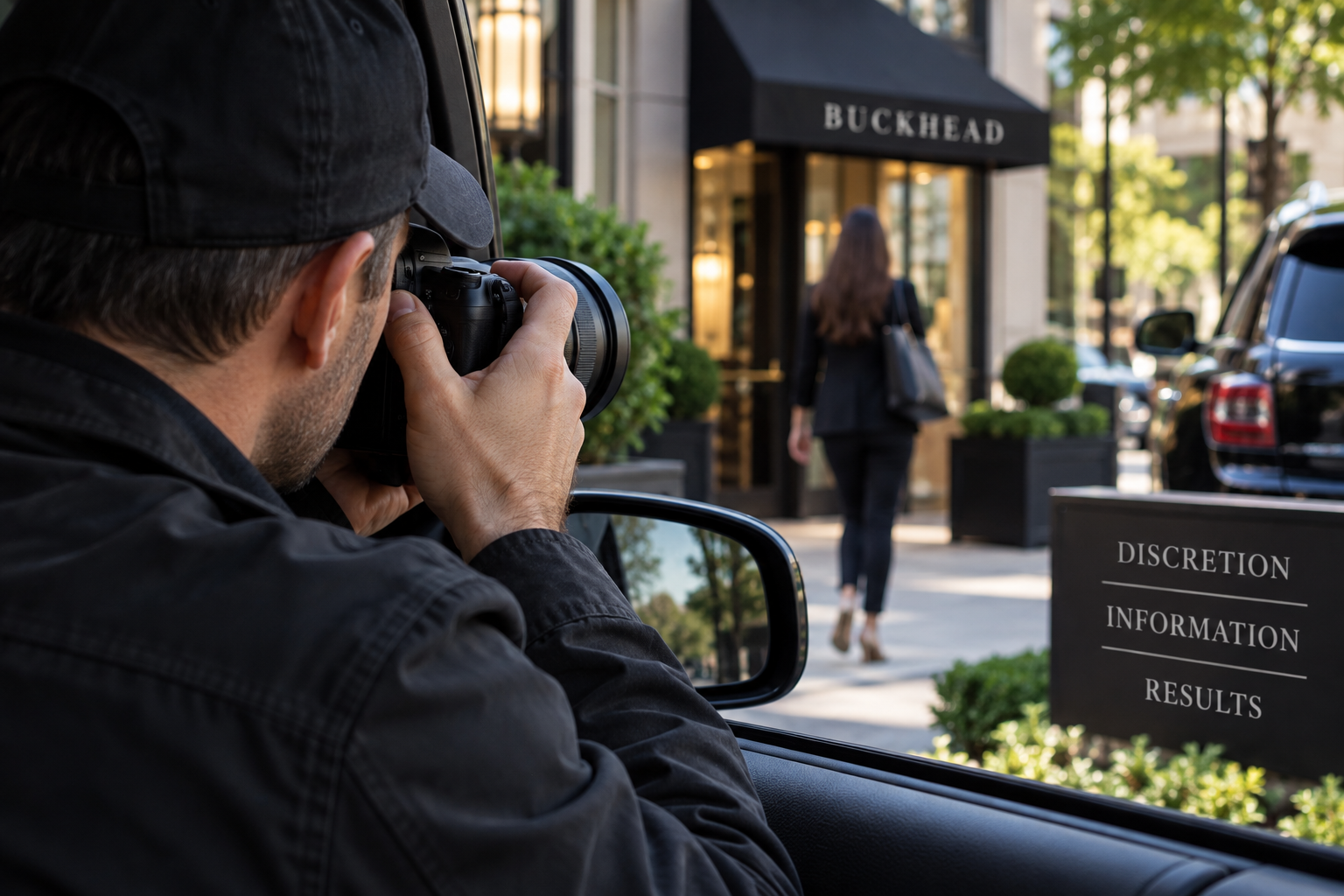
Surveillance is one of the most common investigative tools used in infidelity cases, custody matters, employee misconduct concerns, insurance investigations, and other legal disputes. However, surveillance must be done professionally and lawfully.
A private investigator may document public activity, movements, meetings, locations, arrivals, departures, and interactions. They may use photographs, video, written notes, and timestamps to build a timeline.
For example, in a custody-related case, surveillance may document whether a parent arrived late for an exchange, left a child with another person, or visited a location that may be relevant to the case. In an infidelity matter, surveillance may document public meetings, travel patterns, or overnight stays. In a business matter, surveillance may document whether an employee or contractor is engaging in activity inconsistent with their claims.
A professional investigator avoids trespassing, harassment, illegal recording, and unsafe conduct. For more context, read Discreet Surveillance Services in Buckhead: What Clients Should Know and Can a Private Investigator Legally Follow Someone in Georgia?.
Chain of Custody
Chain of custody refers to the process of documenting how evidence is collected, handled, stored, transferred, and preserved. This is especially important when evidence may be challenged later.
For example, if a private investigator collects video footage, the investigator should be able to explain when it was recorded, where it was stored, whether it was edited, who had access to it, and how it was delivered to the attorney or client.
Chain of custody is often discussed in criminal evidence, but the basic concept also matters in civil and family law contexts. The more sensitive or important the evidence is, the more carefully it should be handled.
A private investigator may keep original files, backup copies, file logs, metadata when available, report references, and delivery records. They may also label evidence consistently so an attorney can easily match a photo, video, or document to the report.
The goal is to reduce confusion and protect the integrity of the evidence.
Public Records and Database Research
Not all evidence comes from surveillance. Private investigators often document evidence through public records and lawful database research.
This may include court records, property records, business registrations, professional licensing information, address history, bankruptcy filings, liens, judgments, corporate records, social media profiles, and other public or legally accessible information.
Public records can support many types of cases. In a divorce, records may show property ownership or business affiliations. In a custody matter, records may show address history or legal issues. In a fraud investigation, records may show business connections or prior disputes. In a missing person or witness location matter, records may help identify a current address or contact lead.
However, records must be verified. A private investigator should not simply print the first result from an online database and treat it as fact. Names can be duplicated. Addresses can be outdated. Records can be incomplete. A professional investigator compares multiple sources before drawing conclusions.
For related information, read Background Checks in Buckhead: What a Private Investigator Can Legally Find and What Information Can a Private Investigator Find About Someone?.
Witness Location and Statements
In some legal matters, the most important evidence may come from a witness. A private investigator may help locate witnesses, verify their identity, document contact attempts, and, when appropriate, obtain statements.
Witness documentation must be handled carefully. If an attorney is involved, the investigator may need to follow the attorney’s instructions about whether and how a witness should be contacted. Some witnesses may be represented by counsel. Others may be reluctant, confused, or unsure whether they want to be involved.
A witness statement should clearly identify who gave the statement, when it was given, what was said, and whether the statement was written, recorded, or summarized. The investigator should avoid pressuring or coaching the witness.
For more on this topic, see Can a Private Investigator Help Find a Witness in Georgia?.
Digital Evidence and Online Activity
Digital evidence can include social media posts, online profiles, marketplace listings, website pages, public comments, photos, videos, business listings, and other online activity. Private investigators may use this information in infidelity, custody, fraud, employment, business, and missing person cases.
However, digital evidence must be preserved properly. Online content can be edited or deleted. Screenshots should include timestamps, URLs when appropriate, usernames, visible context, and notes explaining how the content was found. In some cases, attorneys may recommend more formal preservation methods.
A private investigator cannot hack accounts, access private messages illegally, bypass passwords, or use spyware. Ethical digital investigation focuses on public or legally obtained information.
If online research is being used for a legal case, it should be documented in a way that helps establish where the information came from and why it matters.
Evidence for Infidelity and Divorce Cases
In divorce and infidelity matters, private investigators may document public behavior, travel patterns, meetings, overnight stays, lifestyle inconsistencies, or information relevant to hidden assets. However, the documentation must be lawful and objective.
A client may feel emotional, but the report should remain factual. Instead of accusing someone of cheating, the investigator documents what was observed. The attorney can then determine how, if at all, the information may be used.
Related resources include What Proof Can a Private Investigator Gather for Infidelity? and Signs Your Spouse May Be Hiding Assets During Divorce.
Evidence for Child Custody Cases
Custody cases require special care because children are involved. A private investigator may document public observations related to custody exchanges, living arrangements, supervision concerns, travel patterns, or conduct that may be relevant to a parent’s concerns.
The investigator does not decide custody. The court does. The investigator’s role is to gather lawful, objective documentation that may help an attorney evaluate the matter.
Professionalism is especially important in custody cases. Investigators should avoid anything that interferes with the child, intimidates a parent, violates a court order, or creates unnecessary conflict.
For more information, read How a Buckhead Private Investigator Helps With Child Custody Cases.
Working With Attorneys
Private investigators often work directly with attorneys. This can help make the investigation more focused and legally useful. An attorney can explain what facts matter, what evidence may be needed, what legal issues are involved, and what methods should be avoided.
When an investigator works under attorney direction, the final report may be more aligned with litigation strategy. The attorney can decide whether to use the investigator’s findings in negotiations, discovery, hearings, or trial.
If you are involved in a legal matter, it is often wise to speak with your attorney before hiring an investigator independently. That way, the investigation can support the case instead of creating complications.
Final Thoughts
Private investigators document evidence for court by gathering information legally, writing detailed reports, preserving photos and videos, maintaining clear timelines, verifying public records, locating witnesses, and protecting the integrity of the evidence. Strong documentation is factual, organized, and tied to the purpose of the case.
A private investigator cannot guarantee that evidence will be admitted in court. Judges, attorneys, and evidence rules determine how information is used. But a professional investigator can help gather and organize facts in a way that gives attorneys and clients clearer information to work with.
For clients in Buckhead, the right investigator can make a sensitive situation easier to document and understand. If you need help gathering lawful evidence for a legal matter, learn more through the About page or reach out through Contact Us.