When someone cannot be found, the uncertainty can become overwhelming fast. A missing person situation may involve a loved one who has stopped communicating, an estranged family member, a runaway teen, a witness needed for a legal case, a former tenant, a debtor, a beneficiary, or someone who intentionally does not want to be easily located. Not every missing person case looks the same, and not every case begins as an emergency. But when phone calls, online searches, and mutual contacts lead nowhere, a private investigator can help bring structure to the search.
A private investigator in Buckhead helps locate missing persons by gathering information, verifying leads, searching public records, reviewing online activity, conducting interviews, documenting findings, and developing a practical search strategy. The goal is to move beyond guesswork and use professional methods to determine where someone may be, whether they are safe, and how they may be reached when appropriate.
In Buckhead, missing person and locate investigations can involve a wide range of circumstances. The area includes residential neighborhoods, business districts, apartments, hotels, restaurants, professional offices, and frequent movement in and out of Atlanta. A local investigator who understands Buckhead and the surrounding area can help narrow the search, identify patterns, and follow leads discreetly.
Missing Person Cases Are Not Always the Same
When people hear “missing person,” they often think of an urgent emergency involving immediate danger. Some cases do involve serious safety concerns and should be reported to law enforcement right away. If a child, elderly person, vulnerable adult, or anyone believed to be in immediate danger is missing, the first step should be contacting the proper authorities.
However, many locate investigations are different. A person may be hard to find because they moved, changed phone numbers, cut off contact, left a relationship, avoided legal service, disappeared from a job, or intentionally kept their location private. In other cases, the person may not be in danger but still needs to be found for family, legal, business, or financial reasons.
Private investigators often handle these non-emergency locate cases. They can also assist families, attorneys, and businesses when law enforcement is not actively involved or when the situation does not meet the threshold for a police-led missing person investigation.
The Investigation Starts With Known Information
A missing person investigation usually begins with a detailed intake. The investigator will ask what is known about the person, why they need to be located, when they were last contacted, where they were last seen, and what circumstances led to the search.
Useful information may include full name, nicknames, previous addresses, phone numbers, email addresses, date of birth, relatives, friends, employers, schools, vehicles, social media accounts, habits, medical concerns, legal issues, financial stress, relationship conflict, and known locations in Buckhead or the Atlanta area.
Even small details can matter. A favorite gym, workplace, coffee shop, apartment complex, church, professional group, or social circle may become part of the search. A private investigator knows how to organize these details into leads rather than treating them as disconnected pieces of information.
The more accurate the starting information, the stronger the investigation can be.
Public Records Can Reveal Useful Leads
One of the most important tools in a locate investigation is public record research. A private investigator may review address history, property records, court filings, business registrations, marriage or divorce records where available, vehicle-related leads, civil cases, bankruptcy records, professional licenses, and other lawful sources.
Public records can help build a timeline of where a person has lived, worked, owned property, appeared in court, done business, or maintained connections. This is especially useful when someone has moved, changed contact information, or left behind outdated details.
For example, a person may no longer answer an old phone number, but a recent court record, business filing, or property connection may point to a new area. A former address may lead to a relative, landlord, roommate, or employer. A business registration may reveal an updated mailing address or professional connection.
A professional investigator knows that records must be verified carefully. People with similar names can easily be confused. Automated search websites often produce outdated or inaccurate information. A private investigator cross-checks details to reduce false leads and focus on information that appears reliable.
Online Research Helps Build the Picture
Digital footprints can be valuable in missing person investigations. Many people leave clues through social media, professional profiles, public posts, online directories, usernames, business pages, reviews, event listings, and other public online activity.
A private investigator may review public social media activity, recent posts, tagged photos, location references, friends and associates, employment updates, and other online signals. They may also compare online information with public records to confirm whether a lead is current.
This work must be done legally and ethically. A professional investigator should not hack accounts, bypass privacy settings, impersonate someone to gain access, or use illegal methods to obtain private messages. Publicly available online information can be useful, but private digital access is not fair game.
When handled correctly, online research can help identify where someone may be living, working, traveling, or spending time.
Interviews Can Help Confirm Direction
A private investigator may conduct interviews or discreet inquiries with people who may know the missing person. This could include relatives, friends, neighbors, former coworkers, landlords, business associates, classmates, or others connected to the person’s life.
The goal is not to pressure or harass anyone. The goal is to gather information that may help locate the person. An investigator may ask when the person was last seen, whether they moved, whether they mentioned plans, whether they changed jobs, or whether they are known to be staying with someone.
In some cases, people are willing to help but do not know what details matter. An experienced investigator can ask focused questions and identify useful leads from casual information.
Interviews can also help verify whether a person is intentionally avoiding contact. If the individual does not want to be found by a specific person, the investigator must handle that situation carefully and ethically.
Surveillance May Be Used in Certain Locate Cases
Surveillance can be useful when there is a likely location, routine, or known associate. For example, if a missing person may be staying at a certain residence, working at a particular business, visiting a known partner, or using a familiar route, an investigator may conduct lawful surveillance to confirm whether the person appears there.
Surveillance can also help document whether someone is living at a specific address or regularly visiting a certain area. This may be important in legal cases, service of process, custody matters, debt collection, or family concerns.
In Buckhead, surveillance requires discretion and local awareness. The area includes high-traffic roads, private residences, apartments, commercial properties, gated areas, hotels, restaurants, and office buildings. An investigator must work from lawful locations and avoid trespassing or violating privacy.
Surveillance is not always needed, but when records and interviews point to a likely location, it can help confirm the next step.
Private Investigators Help Locate Witnesses
Missing person investigations are not always family-related. Attorneys often need help locating witnesses, former employees, opposing parties, beneficiaries, heirs, or individuals connected to civil, criminal, family, or business cases.
A witness may have moved, changed phone numbers, ignored outreach, or become difficult to reach. A private investigator can help locate that person using public records, address history, professional connections, databases, interviews, and other lawful methods.
Once located, the investigator may provide information to the attorney or help document the location for legal purposes. Depending on the situation, the attorney may then decide how to contact the witness or proceed with the case.
This type of locate work can be especially valuable when legal deadlines matter. An investigator can often move more efficiently than someone conducting a casual search.
Helping Families Reconnect With Estranged Loved Ones
Sometimes families hire private investigators to find relatives they have lost contact with. This may include an adult child, parent, sibling, biological family member, former spouse, or distant relative. The reasons may be emotional, medical, legal, or practical.
A person may want to reconnect, share important health information, resolve estate matters, notify someone of a family event, or simply confirm that the person is alive and safe.
These cases require sensitivity. Not everyone wants contact, and a private investigator must respect privacy and safety concerns. A responsible investigator may locate the person and help facilitate communication in an appropriate way, but they should not force contact or disclose information if doing so could create danger or harassment concerns.
The purpose is to help families seek answers while respecting legal and ethical boundaries.
Locating People for Estate and Probate Matters
Private investigators may also help locate heirs, beneficiaries, relatives, or other individuals connected to estate and probate matters. When someone passes away, attorneys, executors, or family members may need to find people who are entitled to notice, inheritance, documents, or information.
These searches can be complicated if the person moved years ago, changed names, lost contact with the family, or lives in another state. A private investigator can use records research, genealogy-style leads, address history, court records, and interviews to help identify and locate the correct person.
Accuracy is especially important in estate matters. Locating the wrong person or relying on incomplete information can cause delays and legal complications. Professional documentation helps make the process more organized.
Finding People Who Are Avoiding Contact
Some locate cases involve people who do not want to be found. This may include a debtor, former tenant, defendant, business partner, runaway spouse, or person avoiding service of legal documents.
A private investigator may help identify current addresses, employment connections, vehicles, associates, routines, and other lawful leads. If the case involves service of process, the investigator may work with an attorney or process server to support legal next steps.
However, there is an important boundary. A private investigator should not help someone stalk, threaten, harass, intimidate, or harm another person. If the purpose of the search is improper, a responsible investigator should refuse the case.
Professional investigators evaluate not only whether someone can be found, but why the client wants to find them.
Skip Tracing Is a Common Locate Tool
Skip tracing is the process of locating someone who has “skipped” or become difficult to find. It often combines database research, public records, address history, phone number searches, employment leads, associate research, and other investigative methods.
Skip tracing is commonly used for legal cases, debt matters, tenant issues, witness location, family searches, and business disputes. A private investigator may use skip tracing to develop likely addresses, verify whether a person is still connected to a location, or identify new leads when old information is no longer useful.
The difference between professional skip tracing and a basic people-search website is judgment. A private investigator can evaluate which records appear current, which leads are weak, and which information needs confirmation.
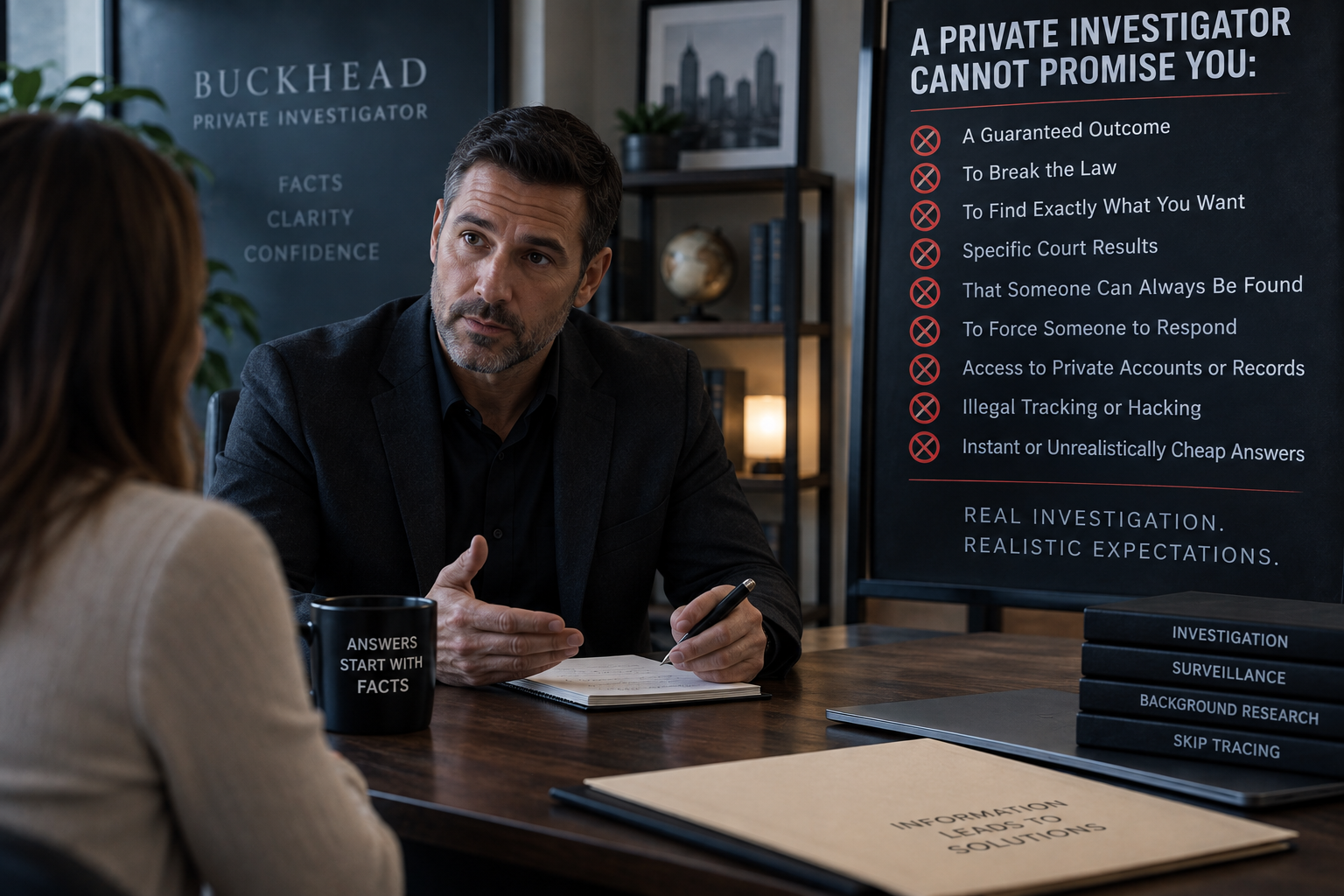
What Private Investigators Cannot Do in Missing Person Cases
Private investigators have limits. They cannot break into homes, hack phones, access private messages, obtain protected medical records, illegally track someone’s location, impersonate law enforcement, trespass, or use threats to obtain information. They also cannot force someone to speak, return home, or contact the client.
If a person is located and is an adult who does not want contact, that choice may need to be respected unless there is a legal reason to proceed through an attorney or court process. A private investigator can provide information, but they cannot override someone’s legal rights.
These boundaries protect everyone involved. A lawful investigation is more credible, safer, and less likely to create legal problems for the client.
Why Local Knowledge Matters in Buckhead
Buckhead has a unique mix of residential, commercial, and social environments. A missing person may be connected to luxury apartments, office buildings, hotels, restaurants, nightlife, medical offices, schools, gyms, or nearby Atlanta neighborhoods. Traffic patterns, parking access, gated properties, and busy commercial corridors can all affect how a search is conducted.
A local investigator understands how to approach these environments discreetly. They can assess whether surveillance is practical, identify likely movement patterns, and avoid drawing unnecessary attention.
For clients, local knowledge can make the search more efficient and more professional.
When to Contact Law Enforcement First
A private investigator can be helpful, but law enforcement should be contacted immediately if there is reason to believe someone is in danger. This includes missing children, vulnerable adults, threats of self-harm, suspected abduction, medical emergencies, domestic violence concerns, or sudden disappearance under suspicious circumstances.
A private investigator may still be able to support the family or attorney in some situations, but emergency safety concerns should not wait for a private investigation.
For non-emergency locate matters, a Buckhead private investigator can help determine whether the case is appropriate and what steps may be available.
Get Professional Help Locating a Missing Person in Buckhead
Locating a missing person requires more than hope and internet searches. It takes organized research, verified records, interviews, lead development, local knowledge, and careful documentation. A private investigator can help families, attorneys, businesses, and individuals find people who are difficult to locate while staying within legal and ethical boundaries.
Whether you are searching for a loved one, witness, heir, former tenant, debtor, or someone connected to a legal matter, professional help can make the process more focused and effective.
If you need assistance with a missing person or locate investigation, contact a trusted private investigator in Buckhead to discuss your situation confidentially and learn what options may be available.