An investment opportunity or business proposal can look convincing at first.
A professional website, polished presentation, impressive financial projections, and confident representatives may make an unfamiliar company appear established and trustworthy.
However, appearances alone do not confirm that a business is legitimate or that an investment is appropriate.
Some fraudulent operations use false identities, misleading company histories, fabricated endorsements, unrealistic financial claims, or pressure tactics to persuade people to send money.
If you are considering a major transaction with an unfamiliar business, independent verification can be an important step.
A private investigator may be able to help research a company’s public background, check factual representations, identify inconsistencies, and document information that deserves closer examination.
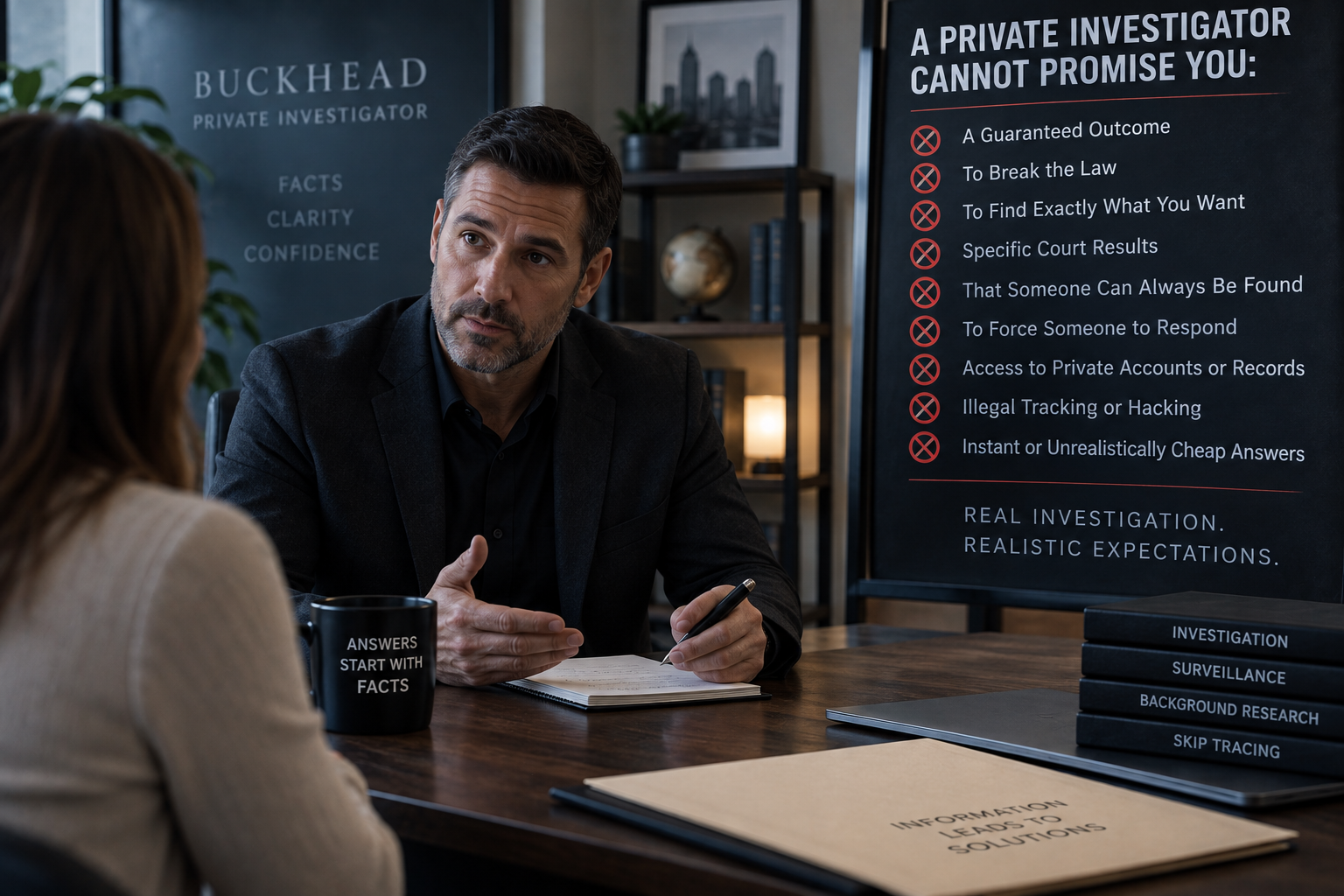
However, an investigator cannot guarantee that an investment is legitimate, profitable, or free of risk.
Why Fake Businesses Can Be Difficult to Recognize
Modern businesses can operate remotely, use virtual addresses, and employ contractors across multiple locations.
That means a company without a traditional storefront is not necessarily suspicious.
At the same time, fraudulent operators may imitate legitimate business practices.
They may create convincing websites, display unauthorized logos, claim nonexistent partnerships, or use names similar to established companies.
Some scams involve real businesses whose identities have been impersonated.
The Federal Trade Commission’s investment scam guidance recommends researching companies, their representatives, and their reputations before committing money.
Verification should focus on independently confirmed facts rather than marketing materials alone.
What Are Common Warning Signs?
Potential warning signs include guaranteed high returns, pressure to act immediately, vague explanations of how the investment works, and reluctance to provide verifiable information.
You may also encounter inconsistent business names, unexplained changes in payment instructions, or representatives who discourage independent advice.
A company may claim to have partnerships with recognizable organizations without providing evidence.
None of these observations automatically proves fraud.
However, several inconsistencies together may justify additional due diligence.
Verify the Legal Business Entity
One useful starting point is checking whether the company exists in the relevant government business registry.
For a Georgia-based company, the Secretary of State’s corporate records can help establish certain registration details.
However, registration is not proof that a company is financially sound, properly licensed for every activity, or operating honestly.
A registered company can still engage in misconduct.
Likewise, a legitimate business operating under a trade name may have a different legal entity name.
The goal is to reconcile what the company claims with what independently available records show.
Verify Investment Professionals Separately
If someone is offering securities or investment advice, checking registration and disciplinary information is especially important.
The U.S. Securities and Exchange Commission provides tools through Investor.gov to check investment professionals.
These tools can help investors research licensing, registration, and publicly disclosed disciplinary history.
A company registration search is not a substitute for checking the individuals who are selling or advising on investments.
Some legitimate offerings may qualify for registration exemptions, so a missing SEC registration is not automatically proof of fraud. Such claims should be evaluated with a qualified securities attorney or adviser.
Can a Private Investigator Help Verify a Company’s Background?
A private investigator may examine public records, company histories, publicly reported litigation, known business associations, and representations about the organization’s operations.
For example, the investigator might compare a company’s claimed years in business with available registration and historical information.
They might research whether its publicly named executives appear to have the professional backgrounds described in promotional materials.
They could also investigate whether a claimed business location appears consistent with the company’s stated activities.
These findings may identify inconsistencies that merit additional questions.
However, publicly accessible information can be incomplete or outdated, and an investigator should explain those limitations.
What About Fake Addresses?
A business address does not necessarily identify where a company conducts its daily operations.
It might belong to a registered agent, mail-receiving service, coworking space, or legitimate virtual office.
An address discrepancy should therefore be investigated in context.
A private investigator may help determine what is publicly documented about a location.
But discovering a virtual office does not, by itself, establish wrongdoing.
The important question is whether the company has materially misrepresented its operations or identity.
Research the People Behind the Opportunity
The identity and background of the people promoting an opportunity may be as important as the business name.
Consider whether individuals’ names, professional histories, licensing claims, and affiliations can be independently confirmed.
Be cautious when an investment promoter claims impressive credentials but provides no verifiable details.
The SEC recommends reviewing registration and background information even when an investment professional has been referred by someone you trust.
This guidance reflects an important principle: personal confidence should not replace independent verification.
Can a Private Investigator Identify Undisclosed Business Relationships?
In some cases, public records and lawful background research may reveal relationships between companies or individuals.
For example, an unfamiliar investment entity may share publicly disclosed officers or business addresses with another organization.
That information might be relevant when assessing the opportunity.
However, shared addresses, agents, or service providers do not automatically indicate improper conduct.
A responsible investigator should distinguish documented associations from speculation.
If the concern involves complex ownership structures or financial representations, an attorney or forensic accountant may also be needed.
Be Careful With Promised Investment Returns
Investment proposals that claim unusually high returns with little or no risk deserve careful scrutiny.
The FTC warns that investment scams often rely on promises of significant returns and pressure to invest quickly.
Genuine investments involve varying levels of risk.
Even a legitimate business can lose money, fail, or produce disappointing returns.
A private investigator’s research cannot replace investment analysis or guarantee future performance.
Before investing substantial funds, consider consulting an independent financial professional who is appropriately licensed and does not receive compensation for promoting the opportunity.
Do Not Rely Solely on Testimonials
Testimonials, online reviews, and success stories may appear persuasive.
Unfortunately, such materials can be fabricated, selectively presented, or taken out of context.
Try to verify claims independently.
For example, a company claiming a prominent institutional partnership should be able to provide information that can be confirmed directly through that institution’s official contact channels.
Avoid relying exclusively on phone numbers or links supplied by the promoter.
Independent verification reduces the risk of communicating with an impersonator.
What Should You Do Before Sending Money?
Before making a payment, establish exactly who will receive the funds, what you are purchasing, what legal agreements apply, and how the transaction will be documented.
Review the proposed contract and financial disclosures.
Do not provide sensitive identity documents simply because a representative says they are urgently required.
Be especially cautious if payment instructions unexpectedly change or if you are pressured to use irreversible methods.
If you are unsure, delay the transaction until the concerns have been resolved.
Legitimate opportunities should withstand reasonable independent due diligence.
What If You Have Already Sent Money?
If you suspect fraud after sending money, contact your financial institution promptly.
Preserve payment records, agreements, communications, advertisements, and other relevant materials.
Depending on the circumstances, you may need to report the activity to the FTC, SEC, law enforcement, or your state securities regulator.
The FTC explains where to report investment scams and how to research suspicious offers.
A private investigator may potentially assist with lawful factual research, but recovery of funds is not guaranteed.
Be wary of anyone who promises to recover lost money in exchange for an upfront fee.
When Does Hiring a Private Investigator Make Sense?
An investigator may be useful when publicly available information is inconsistent, the business representatives are difficult to verify, or the amount at stake justifies deeper background research.
The scope should be specific.
For example, confirming publicly documented business relationships may be more productive than asking for an unrestricted investigation of every individual associated with the opportunity.
You can learn more about Buckhead Private Investigator when considering whether independent investigative work fits your situation.
What Information Should You Provide?
Useful starting information may include the company’s claimed legal name, website, business address, representative names, promotional materials, and the specific statements you want verified.
If you have already received contracts or communications, preserve them.
Avoid sharing passwords or unnecessary sensitive financial information.
An investigator should explain what can be researched lawfully and where the investigation’s limitations begin.
Final Thoughts
A fake business or investment opportunity can be difficult to recognize when the presentation appears professional.
Independent research can help identify inconsistencies involving company registration, professional credentials, business relationships, and publicly available history.
A private investigator may assist with certain factual checks, but cannot guarantee legitimacy, prevent every loss, or determine whether an investment is financially suitable.
For individuals and businesses in Buckhead and Atlanta, careful due diligence before a major financial commitment may reduce uncertainty.
To discuss potential background research, contact Buckhead Private Investigator.
This article is general educational information and does not constitute investment or legal advice.