Suspecting infidelity is emotionally difficult, especially when you do not have clear answers. Many people notice changes in behavior, unexplained absences, unusual phone habits, inconsistent stories, or sudden secrecy, but suspicion alone is not the same as proof. That is one of the reasons people hire a private investigator.
A private investigator can help gather lawful, objective documentation that may confirm or disprove concerns about infidelity. In Georgia, this often involves surveillance, public observation, timeline documentation, photographs, video, vehicle sightings, location patterns, witness information, and factual reporting. The goal is not to harass, embarrass, or invade someone’s privacy. The goal is to collect information legally and discreetly so the client can make informed personal or legal decisions.
For someone in Buckhead, an infidelity investigation may involve a spouse or partner who claims to be working late, traveling for business, meeting friends, staying at a separate residence, or spending time somewhere that does not match what they have said. A licensed private investigator can document what is observable from lawful locations and present it in a clear report.
A Private Investigator Can Document Public Activity
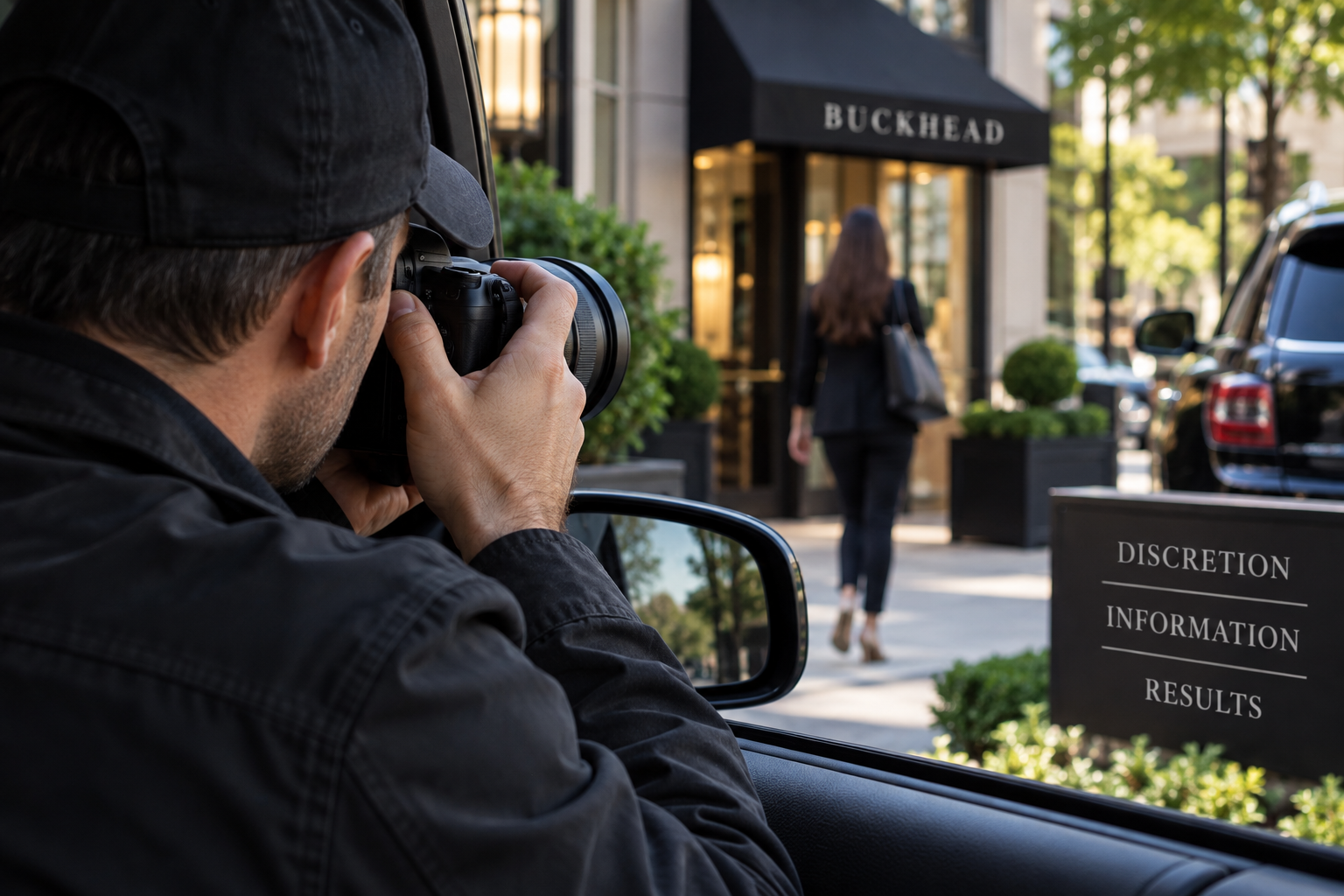
One of the most common types of proof in an infidelity case is documentation of public activity. A private investigator may observe a subject from places where the investigator has a legal right to be, such as public roads, parking lots, sidewalks, business areas, hotels, restaurants, shopping centers, or other publicly accessible locations.
This may include documenting when the subject leaves home, where they go, who they meet, how long they stay, and where they go afterward. For example, if a spouse says they are working late but instead visits a restaurant, hotel, apartment complex, or another residence, a private investigator may be able to document that public movement.
This kind of evidence can include timestamps, written notes, photographs, and video footage. The strongest documentation is factual and specific. Instead of making emotional assumptions, a professional report may state:
“The subject exited the residence at 6:42 p.m., entered a black SUV, arrived at the restaurant at 7:11 p.m., met with an unidentified individual, and left the location at 9:03 p.m.”
That kind of timeline is much more useful than a vague statement like “they seemed suspicious.”
Photographs and Video Footage
Photographs and video are often important parts of an infidelity investigation. A private investigator may capture images or footage of the subject entering or exiting locations, meeting another person, driving a particular vehicle, staying overnight at a location, or engaging in behavior relevant to the investigation.
However, private investigators must respect privacy laws. Georgia law restricts certain types of eavesdropping, surveillance, and recording that invade privacy. For example, it is unlawful to secretly overhear or record private conversations originating in a private place, and the law also restricts secretly observing, photographing, or recording activities that occur in a private place and out of public view.
That means a private investigator cannot secretly film inside a bedroom, hotel room, private home, bathroom, or other private space where there is a reasonable expectation of privacy. They also cannot place hidden cameras inside someone’s private area or use illegal recording devices to capture private conversations.
Legal photos and videos are generally focused on what can be observed from lawful, public, or otherwise permissible vantage points.
Timeline Evidence
Infidelity cases often come down to inconsistencies. A spouse may say they were at work, stuck in traffic, meeting a client, staying with a friend, or traveling alone. A private investigator can help build a timeline that confirms or contradicts those claims.
Timeline evidence may include:
Dates and times of departure
Dates and times of arrival
Locations visited
Length of time at each location
People seen with the subject
Vehicle descriptions
Overnight stays
Patterns across multiple days
This type of evidence is especially useful because one isolated event may not tell the full story. A repeated pattern can be more meaningful. For example, a subject visiting the same apartment complex every Tuesday night after claiming to work late may matter more than one unexplained stop.
A private investigator’s report can organize this information in a way that is easier to understand, share with an attorney, or use during personal decision-making.
Evidence of Overnight Stays
One of the more significant types of evidence in an infidelity investigation is documentation of an overnight stay. This may involve observing the subject arriving at a residence, hotel, or apartment in the evening and leaving the next morning.
An overnight stay does not automatically prove a romantic or sexual relationship. However, it may be important evidence when combined with other facts, such as the subject’s explanation, who they were with, previous behavior, or the legal context of a divorce matter.
A private investigator may document the arrival time, departure time, vehicle location, and any publicly visible interactions. Again, the investigator should not trespass, enter private property, look through windows, or record inside private spaces.
The value of an overnight stay is in the factual documentation, not speculation.
Vehicle Sightings and Travel Patterns
A private investigator may also document vehicle movements. This can include observing the subject’s car at certain locations, following the vehicle from lawful distances, noting license plate information, and recording arrival and departure times.
For example, if the subject claims to be at work but their vehicle is parked outside a hotel, restaurant, or private residence, that may be relevant. If the same vehicle appears repeatedly at another person’s residence, that may support a larger pattern.
However, vehicle monitoring must be done carefully. Many people ask whether private investigators can place GPS trackers on cars. In Georgia, GPS tracking can create serious legal issues, especially depending on ownership, consent, protective orders, and the facts of the situation. Georgia’s eavesdropping and surveillance statute includes GPS-related restrictions in certain contexts, and clients should not assume tracking is allowed simply because they are married to the person being investigated.
A reputable private investigator will not casually place a tracker on a vehicle without carefully reviewing the legal circumstances. When in doubt, clients should consult an attorney.
Documentation of Meetings With Another Person
A private investigator may gather proof that a subject met with another person. This can include photos, video, timestamps, location notes, and descriptions of public interactions.
For infidelity cases, this may involve documenting the subject meeting someone at a restaurant, bar, hotel, apartment, workplace, gym, park, or event. The investigator may note whether the two individuals arrived together, left together, embraced, held hands, entered a private location, or spent an extended amount of time together.
It is important to understand that a private investigator usually does not label the relationship unless the facts support it. A professional report should avoid exaggeration. It may describe the interaction rather than make conclusions the evidence does not prove.
For example, the report might say, “The subject and the unidentified female entered the hotel lobby together at 8:14 p.m. and proceeded toward the elevator area,” rather than “The subject was having an affair.”
The facts allow the client or attorney to draw appropriate conclusions.
Social Media and Online Evidence
Private investigators may also review publicly available online information. This can include public social media posts, public photos, tagged locations, public comments, business listings, property records, court records, and other lawful sources.
Social media can sometimes reveal patterns that support an infidelity investigation. A person may appear in tagged photos, check-ins, event posts, or public interactions with another individual. A second account, unusual online activity, or repeated comments from the same person may also raise questions.
However, a private investigator cannot hack accounts, guess passwords, install spyware, impersonate someone to gain access, access private messages without permission, or use illegal digital methods. Publicly available information is different from private communications.
If digital evidence is important, it should be gathered carefully so it can be preserved with dates, screenshots, URLs, and context.
Witness Information
In some cases, a private investigator may identify or interview witnesses. This may include people who have relevant information about where the subject has been, who they have been seen with, or whether certain statements are accurate.
Witness information may come from neighbors, coworkers, friends, business employees, or others who observed relevant events. However, a private investigator must be careful not to harass, intimidate, misrepresent their authority, or pressure people into providing information.
Witness information may be useful, but it is often strongest when supported by documentation such as surveillance notes, photographs, video, or records.
Public Records and Background Information
Private investigators may use public records and lawful databases to gather background information relevant to an infidelity case. This may include address history, business ownership, court records, property records, vehicle-related information where legally accessible, and other data that helps identify people, locations, or patterns.
For example, if a spouse repeatedly visits a property, a private investigator may research who owns the property or whether it connects to a specific person. If an unknown individual appears repeatedly with the subject, the investigator may try to identify that person through lawful methods.
Public records do not prove infidelity by themselves, but they can help connect the dots.
Evidence That Supports Divorce or Custody Concerns
Infidelity investigations are often connected to larger family law concerns. In some cases, a client may need documentation for a divorce attorney. In other cases, the concern may involve parenting time, child custody, overnight guests, unsafe environments, substance use, or violations of court orders.
A private investigator’s findings may help an attorney understand what is happening outside the client’s personal observations. However, clients should remember that not every piece of infidelity evidence will matter legally. Family law issues depend on the facts, the claims being made, and the advice of an attorney.
A private investigator can gather facts, but an attorney should explain how those facts may affect divorce, custody, alimony, or other legal issues.
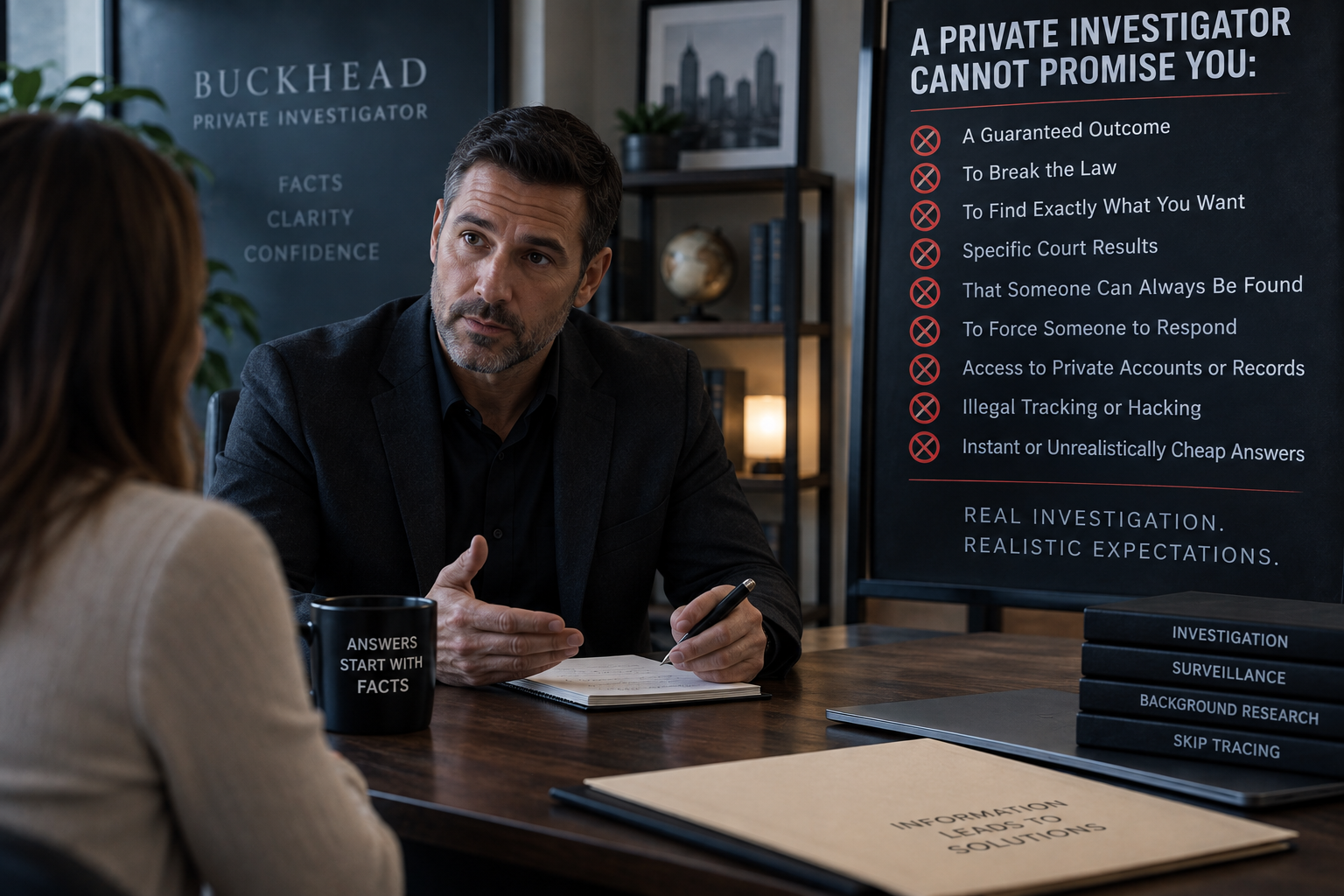
What a Private Investigator Cannot Do
Just as important as knowing what proof a private investigator can gather is knowing what they cannot legally do. A private investigator cannot break into a home, enter private property without permission, hack phones, access private accounts, secretly record private conversations, install spyware, impersonate law enforcement, threaten the subject, or harass someone.
Georgia’s stalking statute is also relevant. Under Georgia law, stalking can involve following, placing under surveillance, or contacting another person without consent for the purpose of harassing and intimidating them. This is why professional investigators must conduct surveillance for legitimate purposes and avoid behavior that could be considered harassment or intimidation.
In Georgia, private detective businesses are also subject to licensing requirements, which include applying for a license and meeting state qualifications. Working with a licensed investigator helps protect clients from illegal methods that could create serious problems.
Why Professional Documentation Matters
When emotions are high, it is easy to misread situations or confront someone without enough information. Professional documentation gives clients a clearer picture.
A private investigator’s report may include dates, times, locations, observations, photos, videos, and a summary of findings. This can help a client decide whether to speak with an attorney, confront the issue, continue gathering information, or move forward with personal decisions.
The best investigative reports are objective. They do not dramatize or make unsupported claims. They present facts in a format that is easier to review and understand.
Final Thoughts
A private investigator can gather several types of proof for infidelity, including public surveillance, photographs, video footage, timelines, overnight stay documentation, vehicle sightings, public social media evidence, witness information, and public records. The strongest evidence is factual, lawful, and clearly documented.
What a private investigator cannot do is just as important. They cannot trespass, hack accounts, secretly record private conversations, invade private spaces, install spyware, or use surveillance to harass or intimidate someone.
If you suspect infidelity in Buckhead or the surrounding Atlanta area, working with a licensed private investigator can help you get answers without taking risky actions yourself. A professional investigator can gather information discreetly, legally, and objectively so you can make decisions based on facts instead of suspicion.